Proud peacock business struts across the Gobi desert
 |
|
[Photo/IC] |
Yang Hui showed a basket of six eggs to visitors to his peafowl farm in the Gobi desert.
"These eggs are laid by blue peafowl which are native to India and Sri Lanka. Each nutritious egg is worth nearly 100 yuan (about 16 U.S. dollars) and our supply can't meet demand," said Yang, deputy general manager of China Peafowl Park, Jiayuguan city, in northwest China's Gansu province.
Yang claims the park is the largest in Asia and last year he sold more than 10,000 eggs. Each peahen only lays about 25 eggs each year. In addition to eggs, the park also sold over 1,000 live birds and countless tail feathers.
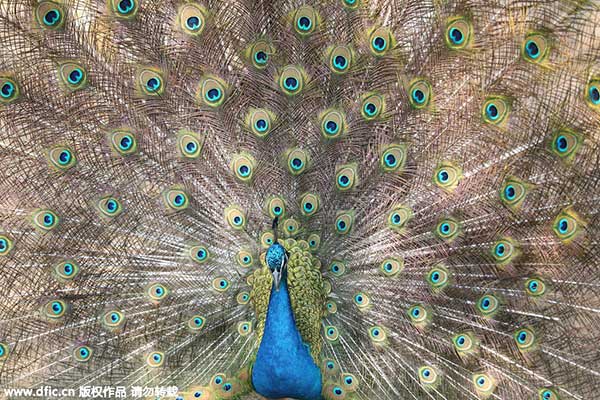
"Individual breeding centers, zoos and private businessmen buy most of the live peacocks, a symbol of good fortune and well-being," Yang said.
Since the late 1990s, the exotic poultry business, including peacocks and pheasants, has boomed in northern China. The park, which has more than 30,000 birds, attracted nearly 800,000 visitors and made over 40 million yuan last year. A restaurant and hotel were built and a wild animal trainer was even employed to teach the birds to fly.
In 2006, Yang's park began to collect the peafowl from farms in India and Sri Lanka as well as from Chinese breeders.
"We chose this bird because it is completely legal to own, breed and and trade, and the market is very profitable," he says. Profit from each blue peacock at five years can reach 2,000 yuan.
Things did not go entirely smoothly at the beginning. The biggest problem was hatching the eggs. Captive bred peacocks don't incubate their own eggs, and so ordinary chickens were used to help them hatch, but the hens have since been replaced by incubators.
Another problem was disease. More than 1,000 birds died one night in 2009, attributed to lack of experience and poor disease control measures. Now peacocks take sand baths to keep their feathers lustrous and get rid of parasites.
How birds native to tropical forests would survive in the Gobi desert was a real worry. Soil was strewn on top of the locals rocks and planted grasses and trees to make birds feel more at home. Heating in their sheds helps them survive the biting cold.
The success of China Peacock Park inspired Zhang Zhiqiang, 25, who began buying eggs from the park in 2013. Now he owns more than 300 peafowl in a small village 25 kilometers away, also in the Gobi desert. Zhang plans to allow his customers to buy birds and products on the Internet.
Yang Hui plans to provide training courses for young people like Zhang who want to start their own business, but right now he and his colleagues are busy training birds to perform in a tourism festival in a few weeks.
"I hope more people will come and see these beautiful birds in the Gobi desert. If they can survive in this tough environment, so can we," he said.