 |
|
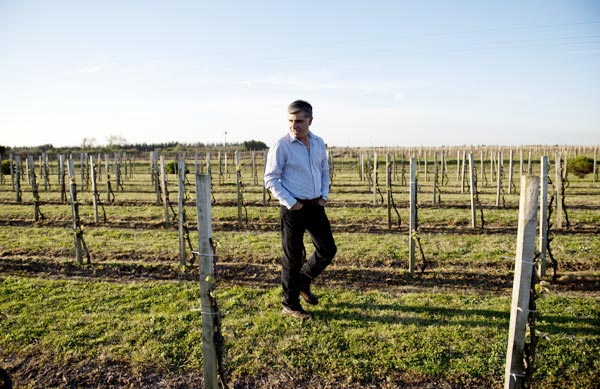
Bernardo Marzuca, the owner of El Legado winery, walks through his property in the Carmelo area, a region in the southwest part of Uruguay, near Argentina, that has been producing wine for generations. Matilde Campodonico / Agencies |
This locus of Uruguayan wine country, though not the largest in this small nation, has been producing wine for generations-but has only recently gained attention as much for its wine as for being an awfully nice place to visit. It's centered around the dusty old town of Carmelo, about 150 miles northwest of the capital of Montevideo and just across the Río de la Plata from Argentina. It's a place of grassy roads, fields of grazing cattle, and hillsides of pale green vineyards. Wildflowers carpet the land and rosemary and lavender plants grow to be the size of small Fiats. It's Tuscany in miniature.
The eight vineyards around Carmelo comprise about 1,000 acres, making the area slightly smaller than Uruguay's biggest wine regions, which are outside Montevideo and Canelones. "Uruguay produces less than 100 million liters of wine every year, which means our entire country produces as much as one large winery in Argentina," said Juan Andres Marichal, vice-president of the National Wine Institute of Uruguay. "Our wineries aren't big corporations. They are small and run by families." If Argentina is the continent's wine Goliath, Uruguay may be on its way to being its David-a formidable opponent. And a huge part of its appeal and success may be that it's small and accessible.
We started early the next day. I met my friends (Lisa, who traveled with me from the States, and Astrid and Matias, who joined up with us in Argentina) on the terrace of CampoTinto for a breakfast of cheese, ham, toast and yerba mate, or simply mate (pronounced MAH-tay), which tastes like green tea if you added bitterness and removed joy. Calling it an acquired taste is generous, and yet it's as popular in Uruguay and Argentina as steak. Mate is served in cups that look like hollowed-out gourds lined with silver, and Astrid and Matias drank theirs through a stainless steel pipe slash straw contraption. It is a beautiful, methodical, centuries-old tradition, and after one sip, I wanted no part of it.
Half an hour later, it was time to borrow bikes from the hotel and get our bearings.
Just down a dusty clay path from CampoTinto is Cordano Almacén de la Capilla, one of the oldest vineyards in Uruguay. "My great-great-grandfather came here in 1870 from Genoa," said Ana Paula Cordano, as we stood in her wine shop and general store, which seem to be lifted from an earlier century.
We had ditched our bikes outside and were perusing jars of dulce de leche and baskets of homemade caramels made from wine. Antique glass bottles and scales lined the shelves, and dings from the ancient cash register added to the feeling that we had stepped into a saloon in the old west.
"He brought with him the Italian tradition of planting grapes," Cordano said, referring to the vineyard's founder. "We had to modernize, but we try to preserve tradition." That tradition was on display in the field just behind the Cordano store-an antique wine press, old hazelnut trees, and just beyond the yard, cows and horses grazing in the pasture as they have for generations.
Only a few miles from CampoTinto-everything is only a bike ride away in Carmelo-is El Legado winery, one of the smaller, more elegant wineries in the area. "What we have in Carmelo is a microclimate," said Bernardo Marzuca, the tan, crisply dressed owner of the winery, which he opened in 2007 (he released his first vintage in 2011). It was the following evening, and we were sitting at the heavy wooden table in his tasting room, surrounded by wine-stained oak barrels, platters of salami, olives and breadsticks, and antique revolvers hanging from the door frame. "The harvest in the rest of Uruguay is in March, but here in Carmelo, the grapes mature faster, so the harvest is two weeks earlier." He stood up, and walked over to one of the formidable oak barrels next to us.

Copyright 1995 - . All rights reserved. The content (including but not limited to text, photo, multimedia information, etc) published in this site belongs to China Daily Information Co (CDIC). Without written authorization from CDIC, such content shall not be republished or used in any form. Note: Browsers with 1024*768 or higher resolution are suggested for this site.
License for publishing multimedia online 0108263 Registration Number: 20100000002731 















 Raymond Zhou:
 Pauline D Loh:
 Hot Pot
 Eco China
 China Dream
 China Face