 |
|
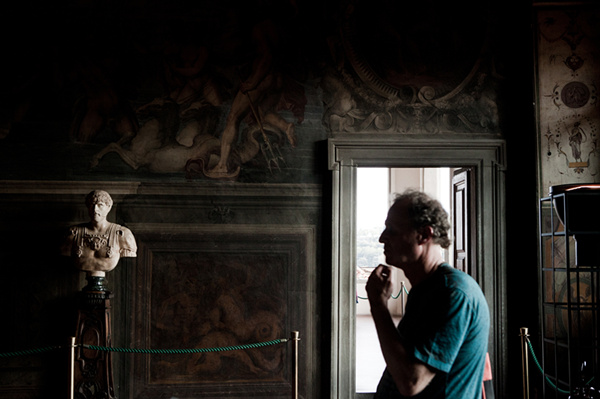
Art on display in the Palazzo Vecchio, where Machiavelli spent almost two decades signing edicts and accruing influence.[Photo/China Daily] |
Even today the Palazzo Vecchio remains the civic heart of the Florentine government (briefly, in the 19th century, Florence was the capital of Italy): People still pick up business licenses at the commune office, or get married in its "Red Room," while the city's mayor meets with the town council in the marvelous Hall of 500, also with frescoes by Vasari. It's here that I met my Florentine guide, Silvia Ponticelli. We made our way through the palazzo to the top floor of the old Chancellery, a tucked-away dark wood-paneled space where Machiavelli spent almost two decades signing edicts and accruing influence with the interim regime.
Ponticelli and I marveled at the fact that the beautiful building (except the private offices) remains completely open to the general public, despite the exquisite details of the structure and fragile art it contains. She told me that when Renzi was mayor-a position he served in for five years here-he removed the metal detectors from the palazzo's entrance. "He said Florentines deserved to come into his office, and that the mayor was the same as any of them," Ponticelli told me. It was a symbolic gesture that Machiavelli would have appreciated, making me think of his line "He who becomes a Prince through the favor of the people should always keep on good terms with them; which it is easy for him to do, since all they ask is not to be oppressed."
"The modernity of his thought is what is most interesting to me," Ponticelli explained. "Machiavelli learned from the history of things and then adapted them to the present. He had a large sense of civic consideration and personal responsibility combined with a sense of what served the greater good of the people. But, of course, it was a time of city-states and violence, so one has to look at his talk of force within that context."
Near the Palazzo Vecchio, the imposing white-marble-fronted Basilica of Santa Croce glinted in the late summer sun. This church was once the sanctuary for Florence's displaced, and remains one of the most important Franciscan structures in Italy, the religious counterpoint to the Palazzo Vecchio. It is also a burial ground where Florence's most famous personalities are memorialized. Not only is there an empty tomb for Dante (who was also in exile at the time of his death and whose actual ashes lie in Ravenna), but Michelangelo and Galileo, as well as Machiavelli are interred there. An epitaph on Machiavelli's tomb reads, "Tanto nomini nullum par elogium ("There is no eulogy to befit so great a name"), which is more than a little surprising, given that he was a political pariah, an atheist, and banned from entering the building during the last years of his life. He was originally buried in the churchyard outside, but by the 1700s Florence's citizens had recognized Machiavelli's brilliance and brought him inside to be near their other great minds. "It's a cultural pantheon: literature, art, science and politics," Ponticelli said. But it is also a monument to Florence's ability to embrace and restore reputations of its fallen men.
Not all of Machiavelli's haunts are as well visited as Palazzo Vecchio and Santa Croce. He used to walk in the nearby Oricellari Gardens (open by appointment), when the Medicis allowed him to return briefly to his beloved Florence-in fact, Machiavelli died in the city, in a spot marked by plaques, at 18 via de Guicciardini, between the Ponte Vecchio and the Pitti Palace. I was alone as I wandered through the landscaped pathways and past the hulking statue of the Cyclops, Polyphemus, caught in a bacchanal pose just hours before Odysseus blinds him and escapes his lair. I wondered whether to Machiavelli it was a particularly satisfying tale, the much more powerful creature ultimately brought down by the machinations of a crafty thinker.
"Everyone sees what you appear to be, few experience what you really are," Machiavelli wrote in "The Prince." And indeed it was only upon touring the antique stone village where Machiavelli lived and wrote during the years of his exile that I best came to understand the man, especially because of the excellent guided tour that the house museum there offers.
The bust of Machiavelli in the Palazzo Vecchio is a relief thought to be taken from his death mask. It shows a rather brooding face, a thin-lipped and sharp-boned figure. In fact I had imagined before my visit to his hamlet that he was a man of few passions besides work and politics. But on my tour I learned how he was a man of huge appetites: In addition to his own seven legitimate children, he managed to be something of a Tuscan Casanova, enjoying women all over Italy, and he drank copiously, too: "After dinner, I go back to the inn: here are the innkeeper, and usually a butcher, a miller, and two bricklayers. In their company I roguify myself all day," he wrote.
After the reveling, back in his study at a heavy desk much like the one in Palazzo Vecchio, he would spend the evening on the work that would come to define him. "For four hours," he wrote, "I feel no boredom, I forget every worry, I don't dread poverty, nor has death any terrors for me."
At Albergaccio, the inn where Machiavelli once caroused, I sat under the barreled ceiling for wine and a hearty lunch of pici with wild boar sauce. Earlier in the tour the guide explained that there was still a secret tunnel underground that led between his home and the tavern.
"He was scared that perhaps the Medicis would assassinate him so it was an emergency exit, but it was also a way to get to the inn or local women without his wife noticing."
It made me giggle to think how his cunning mind could be applied to both lofty political thought and randy desires. But such was the dichotomy between Machiavelli the writer and civil servant, and Machiavelli the lover and farmer exiled in the countryside.
|
|
|
|
|
|
|
|

Copyright 1995 - . All rights reserved. The content (including but not limited to text, photo, multimedia information, etc) published in this site belongs to China Daily Information Co (CDIC). Without written authorization from CDIC, such content shall not be republished or used in any form. Note: Browsers with 1024*768 or higher resolution are suggested for this site.
License for publishing multimedia online 0108263 Registration Number: 20100000002731 


















 Raymond Zhou:
 Pauline D Loh:
 Hot Pot
 Eco China
 China Dream
 China Face