 |
|
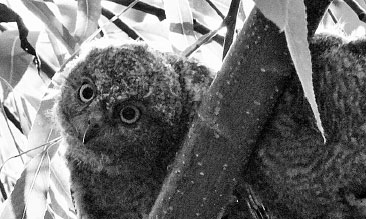
The owl was regarded as the Divine Bird as far back as the Qing Dynasty (1644-1911). [Photo by Lei Hong/For China Daily] |
Lei is an avid birdwatcher, traveling all over Beijing and neighboring provinces all year round with his telescope and cameras. He can identify various species by their calls within two or three seconds. He attributes his acute sense of hearing to a decade of keeping caged birds.
Lei recalls: "I raised 70 birds on my balcony in 1989."
He was a regular at Beijing's bird market. "I would buy birds I was unfamiliar with, no matter where they came from." He remembers a couple of birds from Indonesia cost him 60 yuan, which was a big sum in the 1990s.
His largest cage-1.5 meters wide and 0.8 meters high - had a tree stump where birds could perch and rest.
Every summer, Lei would wash the cages with hot water and disinfectant. He read widely about birds and even learned some veterinary skills. If a bird was ill, he would make medicine for it.
Even at home, he liked to watch his birds through binoculars, which helped him find "interesting details," such as when the birds dozed, fought and bred.
"I was very depressed when they died," says Lei, who would bury them in his flowerpots.
Resonance
In 1996, he read an article about Friends of Nature, China's first environmental NGO. He wrote to its founder, and became a member the next year.
The way the members cared for birds was a revelation. "They wanted people to observe birds in the wild. Cages were a selfish hobby that harmed birds," says Lei.
He said goodbye to his birds and set them free. "I released the northern birds at parks, and the southern ones I released during the migration season," Lei recalls tearfully.
But he was reborn. He returned to the natural environment, traveling around Beijing and neighboring provinces to watch birds. He went as far afield as Xinjiang.
He loves to photograph birds, regardless of the weather, mosquitoes or physical discomfort. He once snapped a yellow bittern bird just before it hit the water to catch a fish in a pond.
The picture won him acclaim on bird watching websites.
Fans say Lei's pictures are "full of humanity". He calls a walking magpie "a smart gentleman"; he describes a sparrow hawk in the water as "taking a cold bath"; and in his eyes, a washbowl-sized nest looks like a bird "mansion".
"Their world is similar to ours," he says, "with joy and pain, poverty and wealth."
In 2013, Lei quit his job at a travel agency and had more time to watch birds. He volunteered to do bird surveys, lectured in schools, and joined a growing group that included foreign birdwatchers.
Birdwatching, however, was little known in China until the 1990s.
In 1958, shortly after Lei's birth, China's central government waged a nationwide campaign to eradicate "four pests": rats, sparrows, flies and mosquitoes.
People believed sparrows stole grain, and this was supported by biologists.
About 450,000 sparrows were killed in Beijing in three days that year, according to a report in the People's Daily.
But cockroaches flourished with-out the sparrows in early 1960.
Bird watching as a hobby grew in the 1990s in Beijing and other big cities. Zhao Xinru notes that the mainland has about 40 specialized birdwatching organizations.
Terry Townshend, a British man who works for an environmental organization, has been a birdwatcher in Beijing for four years.
He was amazed to record 460 species in the capital. "It's as an ideal service station" on bird migration routes, he says.
The number of bird watchers in China is still relatively small, but he believes it will grow as Chinese people have more leisure and wealth.
After the hardships of the "cultural revolution" (1966-76), Lei devoted most of his time to making money. But years of bird watching have made him an admirer of their freedom and casual lifestyle.
"It allows me to focus without distractions," says Lei.
However, not all bird watchers have found inner peace.
Lei once caught a photographer throwing stones to wake up owls in the daytime and others who lure birds close with food for the sake of a good picture.
"They just like the picture, not the birds," he says. "How can you impose your thoughts on another species and disturb its way of life?
"Such behavior violates natural law and will eventually affect our own existence."
|
|
|
|
|
|
|
|

Copyright 1995 - . All rights reserved. The content (including but not limited to text, photo, multimedia information, etc) published in this site belongs to China Daily Information Co (CDIC). Without written authorization from CDIC, such content shall not be republished or used in any form. Note: Browsers with 1024*768 or higher resolution are suggested for this site.
License for publishing multimedia online 0108263 Registration Number: 20100000002731 






















 Raymond Zhou:
 Pauline D Loh:
 Hot Pot
 Eco China
 China Dream
 China Face