 |
|
Cai Meng/China Daily |
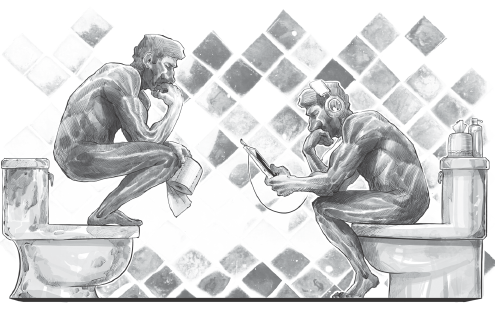
As China aims to install 33,500 new toilets across the nation, many say squatting is healthier and cleaner, but are their reasons based mostly on myth?
Wang Le, 31, will scrub a public sit-down toilet seat twice over with paper before tossing a piece of paper in and carefully sitting on it.
"Too much is at stake," he says.
The Beijing resident says it is risky to have skin contact with not only the public toilet seat but also the potentially foul water that can splash up from the bowl.
"I picked up a tip online about throwing paper into the bowl to keep toilet water from spattering my body," he says.
An independent online straw poll in January showed that 88 percent of 215,120 respondents prefer to use a squat toilet, the Singapore-based Straits Times reports.
In fact, most Chinese consider it cleaner to squat. But while Chinese are accustomed to using the squat-style toilets, foreign visitors to China find it a tough task to mount.
"I've never thought I had to squat to answer the call of nature until I visited China," says Jimena Olivera Fominaya, a 24-year-old Spanish student currently studying Chinese at Liaoning University. Spain does not have squat toilets, she adds.
With the China National Tourism Administration in the midst of a national toilet program, which kicked off in January, choices between squatting and sitting down on toilets have been quite the tender spot in public discussions.
The reform aims to establish 33,500 new toilets and upgrade 25,000 existing ones within three years at tourist spots, highway stops and restaurants.
Those in favor of sit-down toilet argue it is effortless to comfortably sit on the loo while reading books, listening to music or playing with mobile phones.
Studies, including a 2003 study from an Israeli doctor named Dov Sikirov that was published in Digestive Diseases and Sciences, show that squatting results in fewer instances of constipation, less bloating and less straining, along with faster elimination, better muscle tone and improved colon health. Opponents of squatting argue that long periods of time squatting can lead to dizziness.
Roca, which is one of the world's biggest sanitary manufacturers and headquartered in Spain, said an increasing number of its consumers prefer sit-down toilets for a better experience.
The company sold 1.17 million sit-down toilets in China in 2014, it tells China Daily, while sales of squat toilets dipped from 3.7 percent in 2011 to 3.2 percent last year.
The company says its sit-down toilets are mostly bought for public venues in second-and third-tier cities, especially in shopping centers and hotels.
But while urban areas are flush with sit-down toilets, squat-style pans are the norm in rural areas in China because of underdeveloped sewage pipes and where many rural residents dig holes in the ground to use as toilets.
Currently in China, most tourist attractions use squat toilets.
Zhao Xiandong, a 49-year-old public sanitary worker who cleans one of the public toilets outside Lama Temple in Beijing, claims travelers prefer to use squat toilets in tourist spots.
The facility has only one sit-down toilet that is intended for senior citizens, pregnant women and the disabled.
"I think the main reason that squatting pans are widely used in tourist attraction sites is people's concerns about hygiene," he says.
Chinese people's concerns about using sit-down toilets in public venues is mostly psychological, explains Song Peihua, a senior doctor at the China-Japan Friendship Hospital's dermatology and venereology department.
"It's highly unlikely for people to contract infectious diseases when sitting down on toilets," says Song, who adds that toilet seats are not ideal environments for viruses. "The toilet water flows when we flush the toilet, so the density of viruses will be reduced. The chances are slim that you'll contract something from sitting on a toilet."
Still, it's hard to dissuade many Chinese from a long-held belief that sitting down on a toilet is unclean. Many Chinese, in fact, actually squat on top of a toilet seat, which not only stains the bathroom but also poses hazards.
"We often found stains on sit-down toilet seats," says Jiang Shuihu, project supervisor at the Jinji scenic spot in Suzhou, Jiangsu province.
On April 16, a person broke the toilet seat while squatting on top of a sit-down toilet at the Hefei Xinqiao International Airport. The ruptured toilet seat scratched the person's hip. Obviously, there are pros and cons to both squat and sit-down toilets, though Zhang Lingyun, deputy dean of the tourism college at Beijing Union University, said it is essential to help travelers change their mindsets about toilets.
"In their unconscious mind, many Chinese people believe a public toilet is a dirty place," says Zhang, who adds that governments should strengthen the management of public toilets to prevent the possibility of contracting diseases.
Liu Simin, deputy secretary-general of the Beijing Tourism Society, says tourism authorities should build more public toilets, ensure their cleanliness and educate the public about the proper use of them, the Straits Times reports.
"Squat and pedestal toilets each have their place and can coexist in China," Liu was quoted as saying.
|
|
|
|
|
|
|
|

Copyright 1995 - . All rights reserved. The content (including but not limited to text, photo, multimedia information, etc) published in this site belongs to China Daily Information Co (CDIC). Without written authorization from CDIC, such content shall not be republished or used in any form. Note: Browsers with 1024*768 or higher resolution are suggested for this site.
License for publishing multimedia online 0108263 Registration Number: 20100000002731 



























 Raymond Zhou:
 Pauline D Loh:
 Hot Pot
 Eco China
 China Dream
 China Face