 |
|
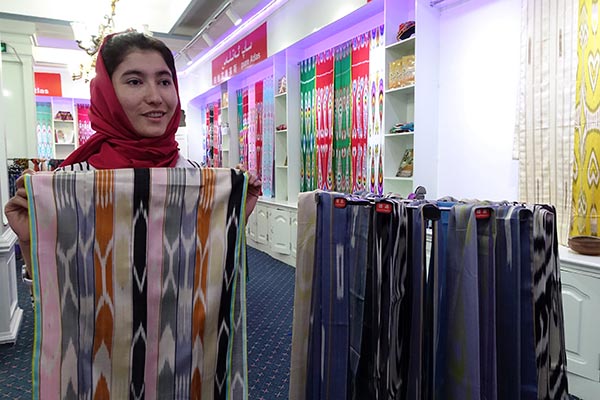
Buzurem Meturoz shows a piece of etles to visitors. The 23-year-old has been learning to color etles in the small factory for four years. [Wang Zhuangfei / China Daily] |
Etles is a Uygur word that means tie-died. In the wardrobes of Uygur women, dresses made of etles with unique patterns and bold color combinations are a must. When people think about Uygurs, the image of a beautiful young girl with long braided hair in an etles silk dress and a dopa, a traditional four-pointed flat hat, may well spring to mind.
For Ausman, the most difficult part of weaving etles is to locate the broken thin silk threads and piece them back together with a tiny knot that needs to be almost imperceptible.
"I am getting old now," he says, trying to locate a broken thread. "My eyes have become blurry and my hands are shaky so I cannot weave as fast as I used to but I don't want to stop because it feels like I'm creating something with lives instead of pieces of silk."
Of all the processes in etles making, weaving is in fact the easiest part, Ausman says. The most difficult and crucial job is to tied-dye the silk and arrange the colored silk for the weavers.
Certain parts of the pure white silk will be clamped tightly together with circles of thick white cotton threads. The parts covered by cotton threads will have no contact with the dye so they will not be colored. During the process some dye will seep into the silk through the edges of the cotton threads to randomly form smudges, which make every piece of etles unique and which has become the distinguishing feature of the traditional Uygur handcraft.
The masters of tie-dyeing are the most respected people in Jiya. The techniques they use are a closely guarded secret. In the workshop, all eltes are tied-dyed with natural colorings extracted from plants accessible by the villagers, who live on the edge of the Taklimakan, the world's second largest desert.
"We use twigs of rose willows that grow in the dessert near us to create the orange color and the skin of fresh walnuts coming from our backyards to dye the silk green," says Buzurem Meturoz, 23, who has been learning to color etles in the small factory for four years. In that time she has gone about the arduous task of becoming acquainted with how to use more than 30 natural colors and to engage her imagination in dyeing and designing etles.
Each etles can have seven to eight different colors, and sometimes it only has two. "There are no rules or boundaries," Buzurem says. "Sometimes we just experiment."
Chemical dyes will impart etles with very bold colors, while any dyed with natural colors will have a softer look.
Jiya was once a part of an ancient kingdom called Yutian, a center of trade on the ancient Silk Road and one of the biggest kingdoms among the 36 kingdoms in Xinjiang first recorded during the Western Han Dynasty (206 BC-AD 24). Records show that the Yutian kings brought large quantities of silk to Central China to trade, and they were very popular.
These days Jiyans have to bring in silkworm cocoons from southern China from which to reel off raw silk because they have cut down the mulberry trees to plant date trees or walnut trees, which are more profitable.
|
|
|
|
|
|
|
|

Copyright 1995 - . All rights reserved. The content (including but not limited to text, photo, multimedia information, etc) published in this site belongs to China Daily Information Co (CDIC). Without written authorization from CDIC, such content shall not be republished or used in any form. Note: Browsers with 1024*768 or higher resolution are suggested for this site.
License for publishing multimedia online 0108263 Registration Number: 20100000002731 


















 Raymond Zhou:
 Pauline D Loh:
 Hot Pot
 Eco China
 China Dream
 China Face