 |
|
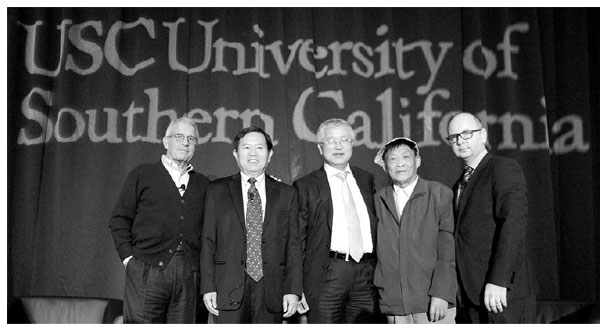
From left: Ron Meyer, NBC Universal vice-chairman; Xu Xin, Nanjing University professor; Ming Hsieh, chairman and CEO of Fulgent Therapeutics and USC Trustee; Chang Zhiqiang, Nanjing Massacre survivor; and Stephen D. Smith, executive director of USC Shoah Foundation, at the USC Global Conference 2015 on Friday. [Photo provided to China Daily] |
More survivors of the 1937 Nanjing Massacre will be interviewed this year as part of a collaborative oral history project being jointly conducted by Chinese and US research institutes.
On Dec 13, 1937, the Japanese military captured Nanjing, which was then China's capital, and over the course of the next six weeks killed as many as 300,000 Chinese civilians and soldiers who had already laid down their arms.
To preserve the testimonies of the last survivors of the massacre, the University of South California's Shoah Foundation Institute for Visual History and Education and the Nanjing Massacre Memorial Hall joined hands in 2012 to create the Shoah Foundation's Nanjing Massacre collection of eyewitness accounts.
The first 12 testimonies of survivors of the 1937 Nanjing Massacre were recorded in December that year and integrated into the Visual History Archive in February 2014. The next 18 testimonies were recorded in September and October 2014.
The average age of the interviewees was 85, with the oldest survivor interviewed 94.
"When it comes to documentary history, it's very important for us to learn specifically and personally about the lives of individuals," said Stephen D. Smith, executive director of the Shoah Foundation Institute for Visual History and Education, who was attending the USC Global Conference 2015 in Shanghai on Friday.
He said it is important to record what the survivors' lives were like before the massacre and how their lives were affected afterwards. "We not only ask about what happened in those terrible months," he said. "We also ask what kind of lifestyle they had, and what happened after and who they have become."
But he said time is running out to talk to the eyewitnesses "who can add new perspectives and understanding to the history of the Nanjing Massacre", and they are trying to record as many as they can to show what happened in the city through their eyes.
Smith said they will start to collect the testimonies of another 30 or so survivors this year, "but it's difficult to say the exact number, as it depends on how many survivors are still alive and how many are strong enough and willing to give their testimonies".
"What's surprising is that each day more people say 'I want to be part of that and tell my story'. So the number could grow to 50 or so. However, the number of survivors is very small now," he said.
The number of Nanjing massacre survivors is reportedly fewer than 200, which makes the videoing of their testimonies even more urgent.
The USC Shoah Foundation also held a panel discussion on "Nanjing: The Power of Survivors' Stories and Why Capturing them Matters" during the conference in Shanghai on Friday.
"A lot of work has been done. More and more people in China and the world are learning more about the massacre in Nanjing," said Chang Zhiqiang, the survivor of the Nanjing Massacre.
During the panel discussion, the 87-year-old recalled his experiences during the Nanjing massacre. Several Japanese soldiers broke into the house where Chang's family members were hiding. His father and two brothers were shot. His elder sister was raped and then killed. A Japanese soldier bayoneted his mother. Chang Zhiqiang's youngest brother who was still a babe in her arms also died later. Only Chang and his other sister survived.
"These video testimonies are very valuable historical records. They allow more people in the world to learn about that terrible part of history in Nanjing," said Zhu Chengshan, curator of the Memorial Hall of the Victims in the Nanjing Massacre by the Japanese Invaders.
In the cooperation with the Shoah Foundation, the memorial hall acts as a link with the Nanjing survivor community and provides expertise in supporting the interview methodology and process.
The Memorial Hall has around 4,000 testimonies of its own, mainly written testimonies collected over the past two decades, with a smaller number of audio-visual testimonies filmed in the 1990s. Copies of the testimonies filmed by the Shoah Foundation will be added to the Memorial Hall's existing collection to be used for research and education.
"In the research program, we are interested in what specifically happened here and how remembering that can help stop such violence continuing to occur," Smith said.
These testimonies will also bring the past alive for the younger generation, as Smith said they will bring these testimonies along with other testimonies together into schools.
The testimonies are also used as the context for a film on the Nanjing Massacre that will be distributed around the world.
USC Global Conference 2015 brought together leaders of the USC community in Shanghai from Thursday to Saturday to examine cutting-edge innovations that are already changing the world and the opportunities they present for the future.
|
|
|
|
|
|
|
|

Copyright 1995 - . All rights reserved. The content (including but not limited to text, photo, multimedia information, etc) published in this site belongs to China Daily Information Co (CDIC). Without written authorization from CDIC, such content shall not be republished or used in any form. Note: Browsers with 1024*768 or higher resolution are suggested for this site.
License for publishing multimedia online 0108263 Registration Number: 20100000002731 






















 Raymond Zhou:
 Pauline D Loh:
 Hot Pot
 Eco China
 China Dream
 China Face