 |
|
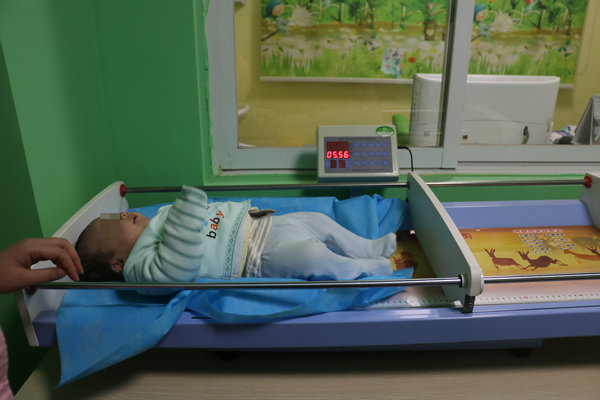
Feifei (pseudonym) is the second cancer-free baby born in Xiangya on Dec 6, 2015. Xiangya produced China's first cancer-free baby with the help of PGD (a cancer screening technology) on March 23, 2015.[Photo provided to China Daily] |
Having cancer can be terrifying. What may be more terrifying is seeing a specific kind of cancer passing down to you from your family tree, and knowing helplessly that it will haunt your children and grandchildren.
Luckily for Wang Wei (who asked China Daily to use her pseudonym for privacy concerns), a 38-year-old new mother who has hereditary multiple exostoses, rare bone growth that can become cancerous in childhood, the family nightmare may finally end.
So may it be for many parents like her in China, as a leading reproductive hospital has successfully produced two cancer-free babies, including one for Wang, using a pre-screening technology called the pre-implantation genetic diagnosis (PGD). The treatment, as an additional procedure to the normal in-vitro fertilization (IVF), essentially selects the embryo that bears no hereditary cancer genes before putting it into a mother's womb.
When Wang, from Zhuhai, Guangdong province, first came to the Reproductive and Genetic Hospital of CITIC-Xiangya in Changsha, Hunan province in March 2013, the then 35-year-old mother-want-to-be was in despair, hoping to give it a long shot at best.
Because of her familial cancer problem, she chose an abortion three years into marriage, and had kept conducting birth controls ever since for fear that her baby may bear the same disease of her paternal family. Many relatives on her father's side and in her generation carry the same bone disease as she does. Medical statistics suggest that there is a 50 percent chance her baby may get the disease, which the World Health Organization says may develop into cancer in every 20 to 200 cases, too high for Wang to risk it.
But deep inside she was still eager to parent a child, and so was her husband. They sought help from various online platforms and learned about Xiangya's attempt to produce babies that are free of familial cancers via PGD.
There was no guarantee at that stage. And the expenses were quite a bite. For one circle - that is to take the eggs and sperms out and combine them into embryos, screen them, and put the healthy ones back into the womb - it costs 50,000 to 60,000 yuan, according to Dong Lei, spokesman for Xiangya.
When the first cancer-free baby was produced using roughly the same technology in London in 2009, it cost about 8,000 British pounds just for the screening.
Wang's first attempt was a failure, which burned up a year's salary. In December 2013, Xiangya picked three healthy embryos out of seven, but none survived in her womb.
Frustrated, Wang sought local doctors for consultation, and they told her it was a hoax.
"Some doctors knew little about the third generation of IVF," Wang says. "Hearing that I'm doing it outside the province (Guangdong), they had certain opinions. They said the technology is beyond China's capability, and Xiangya is cheating patients."
Wang made up her mind and tried again in November 2014. This time, there was only one healthy embryo out of eight extracted, but it stayed and grew. On Dec 6, 2015, her child, the second cancer-free baby in China, was born.
Lu Guangxiu, president of Xiangya, tells China Daily during an one-on-one interview in her office that the current PGD-led medical service offered by her hospital has its limitations.
"I must point out that the so-called cancer-free babies are not absolutely immune to all cancers. They are just free of the specific tumors inherited from their families," Lu says.
Besides that, not all hereditary cancers can be removed from one's family tree, Lu says as she pointed at a chart on her table.
"At current stage, we can only do PGD for patients with cancer of monogenetic inheritance. For instance, the retinoblastoma, neuroblastoma, Wilm's tumor and pheochromocytoma." Wang's tumor falls into that category.
But compared with the relatively less-seen group of cancers passing down in single genes, many widely seen cancers that stick around a family, like certain cancers of the stomach and lung, are caused by multiple genes as well as environmental factors, Lu explains.
"We have a long way to go to use PGD to stop cancers of polygenic inheritance from passing down." Lu says, and she has been working on that.
Huang Jin, a senior researcher with Beijing University Third Hospital who spent more than a decade studying PGD, says technical risks exist in PGD practice and patients deserve to know.
"PGD reaches final diagnosis through conducting invasive practices on the embryos. A long-term and large-sample follow-up is needed."
The first baby produced via PGD selection was born only in 1990, who just turned 26. Huang says that the time is not long enough to tell whether the invasive screening method would leave any harm.
She also cites a research from the European Society of Human Reproduction and Embryology that the average pregnancy rate of PGD is about 23 percent, and says hospitals should inform patients of this.
Aside from practical risks, ethical challenges also exist.
Josephine Quintavalle, co-founder of Comment on Reproductive Ethics, a group that focuses on ethical dilemmas related to reproduction, told CNN after London witnessed the first cancer-free baby that "This is simply a mechanism for eliminating the birth of anybody (prone to) the disease. It is basically a search-and-kill mechanism."
Wang's baby has reached 61 centimeters long and 6.1 kilograms now at three months and a half, normal at its age.
Looking at her baby in her arms, Wang says: "It pleases us the most to be able to give our child a healthy body that bears no extra worries. Looking at it every day, we, like every parent in the world, wish our baby can grow up safe, healthy and happy."
chenmengwei@chinadaily.com.cn
|
|
|
|
|
|
|
|

Copyright 1995 - . All rights reserved. The content (including but not limited to text, photo, multimedia information, etc) published in this site belongs to China Daily Information Co (CDIC). Without written authorization from CDIC, such content shall not be republished or used in any form. Note: Browsers with 1024*768 or higher resolution are suggested for this site.
License for publishing multimedia online 0108263 Registration Number: 20100000002731 






















 Raymond Zhou:
 Pauline D Loh:
 Hot Pot
 Eco China
 China Dream
 China Face