 |
|
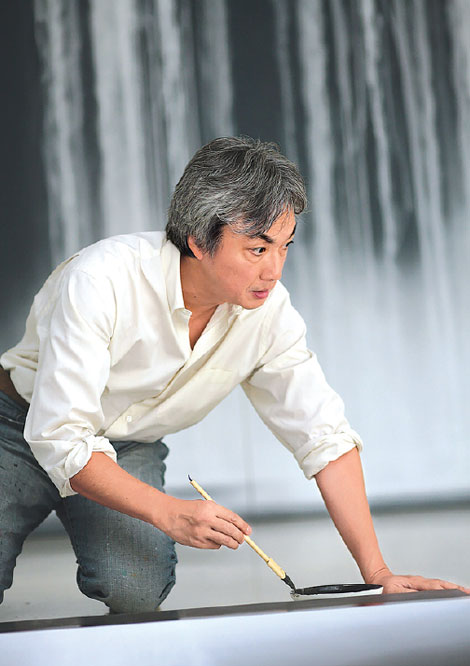
Hiroshi Senju is noted worldwide for his sublime waterfall and cliff images, which are often monumental in scale. [Photo by Kazuya Yamaguchi/provided to China Daily] |
Hiroshi Senju's sublime, large-scale paintings of waterfalls and cliffs are renowned for combining the techniques of abstract expressionism with Japan's centuries-old nihonga style of painting. Senju was the first Asian artist to receive an Honourable Mention Award at the Venice Biennale, his monumental Shrine of the Water God was recently added to the permanent collection of New York's Metropolitan Museum of Art and his oeuvre is showcased in the dedicated Hiroshi Senju Museum in Karuizawa, Japan. In this exclusive interview, Senju explains how nature has inspired his work
Why do you have such a fascination with waterfalls?
When I look at waterfalls, I see amazing, impossible scenery. The constant movement of the water attracts not only human beings, but also any animals that are nearby. I'm interested in the reaction between the water and gravity, and when I paint I pour the pigments from the top of the panels and create a waterfall on the surface of the paper.
Nature seems to play such a dominant role in your art ...
Since the ice age, the primitive era, humans have always tried to capture nature and to communicate with nature. So when you look at cave paintings there are bison or deer painted on the walls of a cave and that shows the curiosity of ice-age people - where did this animal come from and where is it going?
Looking back at the history of art and particularly depictions of nature, who do you most admire and what most influenced you?
I'd probably start 50,000 years ago when the first human made art - painted the animal on the wall, in a cave. And I love Renoir, Monet, Hokusai, Hiroshige ... the Italian Renaissance, too. In American art, Gerhard Richter. American contemporary artists successfully expressed things that you cannot see. Abstract painting has successfully given a form to something that is invisible.
You've said you're not a Japanese artist or an Asian artist. Can you explain how you position yourself in a world context?
In the present day, there is so much separation or alienation by race, whether it's Chinese, Japanese, Middle Eastern, American or European. I think it's very important now to talk as a human being, as a common denominator.
Tell us about the museum dedicated to your work in Karuizawa.
The architect was Ryue Nishizawa. It's constructed mainly with glass and is in the forest - so in a way, it's invisible. There is no artificial light. It's almost like you're walking in nature and you happen to come across my paintings.
And your New York studio is in an old power station?
I used to have a big studio in Tribeca in downtown Manhattan. But my paintings got bigger and bigger, and I could no longer carry them out through the elevator. My wife looked for a new location and found an old power plant in Westchester that I renovated. (The purpose of) a power plant is to generate electricity and bring light to people, so that place is an inspiration to me.
You're currently working on your Cliff series - 18 new pieces that will debut at the Sundaram Tagore Gallery in New York in November, and which will possibly be brought to Hong Kong next year. Can you describe your creative process for those works?
(Senju holds up a piece of paper and scrunches it up to demonstrate.)
I crunch up huge pieces of paper so they are damaged - but looking carefully at them, I can see cliffs. I pour pigment on top of those crushed papers and it falls because of gravity. It's collaboration with a natural phenomenon. In art history, I don't think anybody has used pigment on top of crushed paper. The reason I can do it is because I use Japanese mulberry paper, which is very strong.
Your work has been exhibited in Hong Kong before. What do you like to do when you visit the city?
When I'm in Hong Kong, I go shopping for antiques, especially for old Chinese works of art that surprise and inspire me. An 11th-century Chinese painting is almost like calligraphy - the scenery or the landscape is not brushed, but rather written. It's not just a painting; it shows thoughts and ideas.
(China Daily 05/13/2017 page16)
|
|
|
|
|
|
|
|

Copyright 1995 - . All rights reserved. The content (including but not limited to text, photo, multimedia information, etc) published in this site belongs to China Daily Information Co (CDIC). Without written authorization from CDIC, such content shall not be republished or used in any form. Note: Browsers with 1024*768 or higher resolution are suggested for this site.
License for publishing multimedia online 0108263 Registration Number: 20100000002731 













 Raymond Zhou:
 Pauline D Loh:
 Hot Pot
 Eco China
 China Dream
 China Face