 |
|
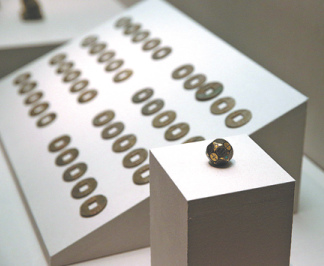
A collection of copper coins and a multi-faceted copper dice embedded with patterned gold and silver and set with agate and turquoise; gilt bronze human-shaped lamp, unearthed from the tomb of Dou Wan. Photo Provided to China Daily |
Liu Sheng laid out his own case at a banquet hosted by the emperor, with what today is regarded as an oratorical masterpiece. The improvised speech is both powerful and persuasive, with what is said to have been his signature eloquence, but with a hefty dose of emotion as well.
However, the emperor was clearly not moved enough to pull back from his course to reduce and undermine vassal power. The empire continued to shrink in the years after Liu Sheng's death. But for the 42 years he lived he enjoyed relative safety on his own turf, nearly 1,000 kilometers from Chang'an, capital of the Western Han Dynasty, in what is now Shaanxi province.
"In retrospect, Liu Sheng's self-proclaimed love of debauchery may have been a ruse designed to fend off potential danger from a wary emperor and his mighty troops," Wu says. "Growing up witnessing the death of his rebellious uncles and grand-uncles at the hands of his own father, Emperor Jingdi, Liu Sheng was wise enough to stay out of harm's way."
Or perhaps over the years the king had convinced himself that to live an intoxicated - sometimes literally so - life was indeed the best for him. Whatever the case, Liu Sheng seemed to have adhered to that hedonic image of his diligently and consistently, nurturing his literary genius over cups of wine.
The king fathered more than 120 sons - and an unrecorded but presumably large number of daughters, a feat that might only be expected of a lecherous Greek god. Were any of these children mothered by Dou Wan? We do not know.
"Many historians believe Dou Wan was a distant relative, possibly a grandniece, of Dou Yifang, the empress of Emperor Wendi and mother of Emperor Jingdi, a strong believer of Taoism who stayed in the center of politics for nearly two decades," Wu says.
"That connection provided Dou Wan with a much needed layer of protection amid all the volatility surrounding a spouse of a king."
Items unearthed from her tomb - some clearly having been used before their burial - offer a glimpse into their owner's life. One is a gilt bronze lamp in the shape of a kneeling maid. Holding the tray, in which blocks of animal fat were placed, with the left hand, the maid lifts up her broad-sleeved right arm to the top of the lamp. (Candles were not invented until much later.)
In an ingenious design touch, the sleeve column serves as a tunnel through which the smoke produced by the burning of congealed oil is channeled into the maid's body. In fact, a vestige of smoke was discovered on the inner wall of the hollow space.
Moreover, both the tray and the shade of the lamp could be turned around, making possible the adjustment of the light's direction and intensity.
"Inscriptions suggest the lamp changed hands several times, before it became owned by Dou Wan and followed her underground," Wu says. "We have reasons to believe that the lamp was treasured by its owner, who might have toyed with it during those long hours of her husband's absence."
The lamp is known today as the "Changxin Lamp", changxin being inscribed on it and referring to the name of the palace where Dou Yifang, the powerful empress dowager, once resided. At the national museum it is displayed alongside a collection of copper coins and a multifaceted copper dice embedded with gold and silver and set with agate and turquoise.
The copper coins and the dice are items of entertainment, used for game play during extensive drinking sessions, Wu says.
"Dou Wan herself may have been a wine lover, given the discovery of wine containers and cups in her tomb. But it's also possible she took part in such activities or even promoted them in an effort to be close to the world of her husband.
"Given the scant information available, whether Dou Wan died before or after her husband is likely to remain unknown. Some historians leaned toward the 'before' view, arguing that the funerary objects unearthed in Dou's tomb were less magnificent than those of Liu. But proponents of the 'after' case point to the woman's burial ground being larger.
When the archaeologists looked inside Dou Wan's coffin in 1968 they found 47 knives. In an era when people recorded things on bamboo slips, the knife was the pen.
"The fact that Dou was wearing it upon her burial says a lot; she is likely to have been a woman of letters. And this hobby could have been the mental and emotional bridge that linked her with the man of her life."
|
|
|
|
|
|
|
|

Copyright 1995 - . All rights reserved. The content (including but not limited to text, photo, multimedia information, etc) published in this site belongs to China Daily Information Co (CDIC). Without written authorization from CDIC, such content shall not be republished or used in any form. Note: Browsers with 1024*768 or higher resolution are suggested for this site.
License for publishing multimedia online 0108263 Registration Number: 20100000002731 


















 Raymond Zhou:
 Pauline D Loh:
 Hot Pot
 Eco China
 China Dream
 China Face