Top News
Scientists find skull of human ancestor
(AP)
Updated: 2006-03-26 09:19
 |
Large Medium Small |
Scientists in northeastern Ethiopia said Saturday that they have discovered the skull of a small human ancestor that could be a missing link between the extinct Homo erectus and modern man.
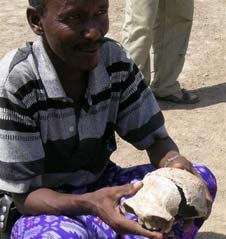 In this photo released by the Stone Age Institute, Gona Project member Ashmed Humet, holds the newly discovered skull of a small human ancestor on Feb. 16, 2006 in Gona, Ethiopia. [AP] |
The hominid cranium — found in two pieces and believed to be between 500,000 and 250,000 years old — "comes from a very significant period and is very close to the appearance of the anatomically modern human," said Sileshi Semaw, director of the Gona Paleoanthropological Research Project in Ethiopia.
Archaeologists found the early human cranium five weeks ago at Gawis in Ethiopia's northeastern Afar region, Sileshi said.
Several stone tools and fossilized animals including two types of pigs, zebras, elephants, antelopes, cats, and rodents were also found at the site.
Sileshi, an Ethiopian paleoanthropologist based at Indiana University, said most fossil hominids are found in pieces but the near-complete skull — a rare find — provided a wealth of information.
"The Gawis cranium provides us with the opportunity to look at the face of one of our ancestors," the archaeology project said in a statement.
Homo erectus, which many believe was an ancestor of modern Homo sapiens, is thought to have died out 100,000 to 200,000 years ago.
The cranium dates to a time about which little is known — the transition from African Homo erectus to modern humans. The fossil record from Africa for this period is sparse and most of the specimens poorly dated, project archaeologists said.
The face and cranium of the fossil are recognizably different from those of modern humans, but bear unmistakable anatomical evidence that it belongs to the modern human's ancestry, Sileshi said.
"A good fossil provides anatomical evidence that allows us to refine our understanding of evolution. A great fossil forces us to re-examine our views of human origins. I believe the Gawis cranium is a great fossil," said Scott Simpson, a project paleontologist from Case Western Reserve University School of Medicine at Cleveland, Ohio.
Scientists conducting surveys in the Gawis River drainage basin found the skull in a small gully, the project statement said.
"This is really exciting because it joins a limited number of fossils which appear to be evolutionary between Homo erectus and our own species Homo sapiens," said Eric Delson, a paleoanthropologist at Lehman College of the City University of New York, who was not involved in the discovery but has followed the project.
Homo erectus left Africa about 2 million years ago and spread across Asia from Georgia in the Caucasus to China and Indonesia. It first appeared in Africa between 1 million and 2 million years ago.
Between 1 million and perhaps 200,000 years ago, one or more species existed in Africa that gave rise to the earliest members of our own species Homo sapiens — between 150,000 and 200,000 years ago.
Delson said the fossil found in Ethiopia "might represent a population broadly ancestral to modern humans or it might prove to be one of several side branches which died out without living descendants."