Top News
Continuing violence kills 30 more Iraqis, most beheaded
(AP)
Updated: 2006-03-27 08:38
 |
Large Medium Small |
Police found 30 more victims of the sectarian slaughter ravaging Iraq — most of them beheaded — dumped on a village road north of Baghdad on Sunday. At least 16 other Iraqis were killed in a U.S.-backed raid in a Shiite neighborhood of the capital.
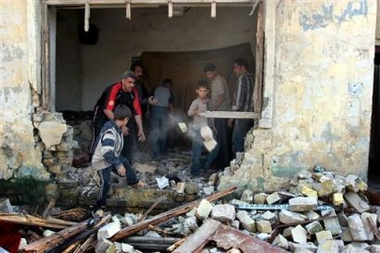 Iraqi men clean the debris of their damaged house, following a bomb explosion, in Baghdad, Iraq, Sunday, March 26, 2006. A bomb exploded in front of a house in the central Baghdad Sunday, killing one woman and wounding two of her sisters and a man next door, police said. Elsewhere, a 13-year-old Iraqi student was killed after a roadside bomb exploded in front of a school Sunday in the city of Basra in southeast Iraq. [AP] |
Accounts of the raid varied. Aides to the Shiite cleric Muqtada al-Sadr and Iraqi police both said it took place at a mosque, with police claiming 22 bystanders died and al-Sadr's aides saying 18 innocent men were killed.
The Americans said Iraqi special forces backed by U.S. troops killed 16 "insurgents" in a raid on a community meeting hall after gunmen opened fire on approaching troops.
"No mosques were entered or damaged during this operation," the military said. It said a non-Western hostage was freed, but no name or nationality was provided.
Associated Press videotape showed a tangle of dead male bodies with gunshot wounds on the floor of what was said by the cameraman to be the imam's living quarters, attached to mosque itself.
The tape showed 5.56 mm shell casings scattered about the floor. U.S. forces use that caliber ammunition. A grieving man in white Arab robes stepped among the bodies strewn across the blood-smeared floor.
A total of at least 69 people were reported killed Sunday in one of the bloodiest days in weeks. Most of the dead appeared to be victims the shadowy Sunni-Shiite score-settling that has torn at the fabric of Iraq since Feb. 22 when a Shiite shrine was blown apart in Samarra, north of Baghdad.
Much of the recent killing is seen as the work of Shiite militias or death squads that have infiltrated or are tolerated by Iraqi police under the control of the Shiite-dominated Interior Ministry.
Many of the victims have been found dumped, mainly in Baghdad, with their hands tied, showing signs of torture and shot in the head.
In an apparent effort to clamp down on police wrongdoing, American troops raided an Interior Ministry building and briefly detained about 10 Iraqi policemen after discovering 17 Sudanese prisoners in the facility, Iraqi authorities reported.
The report was reminiscent of a similar U.S. raid last November that found detainees apparently tortured. That discovery set off a round of international demands for investigations and reform of Iraqi police practices to ensure observance of human rights.
In this case the Americans quickly determined the Sudanese were held legitimately and had not been abused, said Maj. Gen. Ali Ghalib, a deputy interior minister.
The U.S. military command here had no immediate comment.
The raid in Baghdad came a day after U.S. Ambassador Zalmay Khalilzad spoke out on the need to cap the sectarian, militia-inspired killing, saying "More Iraqis are dying today from the militia violence than from the terrorists." He did not say which militias he meant nor did he define who the terrorists were.
The two major militia forces in the country are Shiite organizations — the Mahdi Army of al-Sadr and the Badr Brigades, the armed wing of the Supreme Council for the Islamic Revolution in Iraq. Both have ties with Iran.
Hours before the raid in Baghdad near Sadr City, al-Sadr personally was the apparent target of a mortar attack at his home in the holy city of Najaf, 90 miles south of Baghdad.
At least one mortar round struck within yards of al-Sadr's home, wounding a guard and a passing child, said Sheik Sahib al-Amiri, an aide to the cleric.
Shortly after the attack, al-Sadr issued a statement calling for calm.
"I call upon all brothers to stay calm and I call upon the Iraqi army to protect the pilgrims as the Nawasib (militants) are aiming to attack Shiites every day," he said, referring to Wednesday's commemoration marking the death of the Prophet Muhammad.
Following the raid, Prime Minister Ibrahim al-Jaafari, a Shiite, expressed concern and telephoned Iraqi military leaders and U.S. Gen. George Casey to "discuss the situation," said spokesman Abdul Rezzaq Al-Kadhimi.
He said the prime minister promised government compensation for families of those killed in the raid and called for Iraqis to be patient until an investigation was completed.
Police Lt. Hassan Hmoud, who put the death toll at 22, said some of the casualties were at the Islamic Dawa Party-Iraq Organization office near the mosque. The incident started when U.S. forces came under fire from the direction of the mosque and the party office, he said. The party is a separate organization from the one headed by al-Jaafari.
Shiite legislator and party spokesman, Khudayer al-Khuzai, said 15 members of the party were holding a "cultural meeting" in an office near the Shiite mosque. "They have nothing to do with the acts of violence," he said.
Al-Khuzai claimed that after coming under attack, U.S. forces raided the party office, "tortured" the men, dragged them out and "executed" them. He said it was not clear who attacked the U.S. troops.
The main Shiite political bloc, the United Iraqi Alliance, would demand a quick investigation "because the Iraqi blood is not cheap," al-Khuzai said.
Lt. Col. Barry Johnson, a U.S. military spokesman, denied that the troops targeted a party office.
"The building was not a party headquarters but a community meeting room, and there was substantial intelligence on this building showing that that was not, in fact, what it was used for," he said.
In the north of the country, meanwhile, the Kurdish writer Kamal Karim was handed an 18-month sentence for articles on a Kurdish Web site that accused Masoud Barazani, one of the region's top leaders, of corruption.