Suicide bombers, one dressed as a woman, blasted worshippers as they left a
Shiite mosque after Friday prayers, killing at least 79 people and wounding more
than 160 in the deadliest attack in Iraq this year.
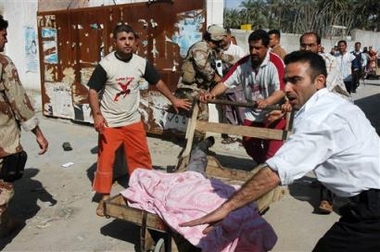
Iraqi men transport the body of a
victim of an explosion at a mosque Friday April 7, 2006 in Baghdad, Iraq.
An explosion rocked a Shiite mosque in northern Baghdad after religious
services Friday, killing at least 30 people, police said.
[AP] |
The horrific explosions at the Buratha
mosque are likely to stoke the already raw tensions between Shiite and Sunni
Muslims. The U.S. ambassador warned in an interview published Friday that
sectarian civil war in Iraq could enflame the entire Middle East.
Rescuers raced to and from the mosque, ferrying bodies from the walled
compound on blood-soaked wooden pushcarts and loading them on the beds of pickup
trucks. City officials urged Iraqis to donate blood for the wounded.
Inside the mosque, blood stained the chipped and crumbling floor next to a
red prayer rug and spattered the dingy white walls of a nearby corridor, where a
cupboard and plates lay shattered. A firefighter wearing a yellow helmet and
yellow gloves kneeled down to inspect the scene in the main prayer room.
Police said there were two suicide bombings at the mosque, and an Associated
Press photographer saw evidence of two blasts ¡ª one at the outer wall
surrounding the compound and another at the entrance to the mosque building. The
blast in the entrance likely killed some worshippers inside.
But Jalal Eddin al-Sagheer, the preacher at the mosque and one of the
country's leading politicians, said there were three bombings. One assailant
came through the women's security checkpoint and blew up first, he said.
The preacher, who was not injured, said another raced into the mosque's
courtyard while a third tried to enter his office before they both detonated
their explosives.
Al-Sagheer accused Sunni politicians and clerics of waging "a campaign of
distortions and lies against the Buratha mosque, claiming that it has Sunni
prisoners and mass graves of Sunnis."
"Shiites are the ones who are targeted as part of this dirty sectarian war
waged against them as the world watches silently," he told Al-Arabiya
television.
Mainstream Sunni Arab politicians condemned the bombings, calling on all
religious and political leaders to come together in the interest of national
unity.
"Bloodshed is forbidden," Sunni lawmaker Adnan al-Dulaimi told Iraqi
television.
Also Friday, the U.S. military reported the deaths of four more American
service members, including one who died from wounds suffered in Baghdad. Two
Marines and a soldier were killed Thursday.
An Iraqi soldier allegedly shot and killed one of the Marines at a base near
the Syrian border, and the Iraqi was then wounded by another Marine, a U.S.
statement said. At least 2,349 members of the U.S. military have died since the
beginning of the Iraq war in March 2003, according to an AP count.
The mosque attack occurred as worshippers left Friday prayers, the main
weekly religious service. Several hours earlier, the Interior Ministry warned
the public to avoid crowds near mosques and markets because of a car bomb
threat.
"I heard an explosion after we finished praying," said Jamal Hussein, a
40-year-old teacher who was one of the wounded worshippers. "Next thing, I found
myself in the hospital," he said from his hospital bed, his left arm wrapped in
bandages.
Also hospitalized was Haidar Mohammed, 25, who suffered shrapnel wounds to
the leg.
"When I heard the second explosion, I felt like everything went black," he
said. "I think I passed out."
Police Lt. Col. Falah al-Mohammedawi, who gave the casualty figures, said one
of the suicide attackers wore a black abaya, the full-length robe worn by devout
Muslim women. He said police were unsure whether the attacker was a man wearing
a woman's robe to conceal explosives.
At the compound's entrance, the AP photographer saw a leg and most of the
head of what appeared to be one of the bombers. The skull had long hair and the
leg was thin, and the photographer thought it was the remains of a woman.
Women have carried out suicide bombings on Israeli targets and last year on a
hotel in Jordan, but only rarely in Iraq.
On Nov. 9, 2005, Muriel Degauque, a 38-year-old Belgian woman, blew herself
up near an American military patrol after entering Iraq from Syria a month
earlier. She was the only person killed in the bombing.
The attack on the mosque was the second in as many days against a Shiite
religious site. On Thursday, a car bomb exploded about 300 yards from the Imam
Ali mosque in Najaf, killing 10 people. Najaf, 100 miles south of Baghdad, is
the most sacred city in Iraq for Shiite Muslims.
No group claimed responsibility for either attack, although suspicion fell on
Sunni extremists responsible for numerous bombings against Shiite civilians. The
Buratha mosque is affiliated with the Supreme Council for the Islamic Republic
in Iraq, the country's main Shiite party. The party said the attacks were part
of "a war of annihilation" against Shiites.
On March 13, a coordinated car bomb and mortar attack killed at least 58
people in a market in Baghdad's predominantly Shiite area of Sadr City. A
suicide bombing Jan. 5 killed 63 people near a Shiite shrine.
Rising sectarian tensions ¡ª worsened by armed, religiously based militias and
death squads ¡ª have emerged as a significant threat to U.S. efforts to form a
stable society in Iraq. Those tensions escalated dramatically after the Feb. 22
bombing of a Shiite shrine in Samarra.
That triggered a wave of reprisal attacks against Sunni mosques and clerics ¡ª
many of them believed carried out by Shiite militias ¡ª and drove the country to
the brink of civil war. Hundreds of Shiites have also been killed in attacks
since the shrine bombing.
In an interview with the British Broadcasting Corp., U.S. Ambassador Zalmay
Khalilzad warned that Iraq faced the possibility of sectarian civil war that
could engulf the Middle East.
"That's a possibility if we don't do everything we can to make this country
work," he said. "What's happening here has huge implications for the region and
the world."
The ambassador said the best way to prevent such a conflict was to form a
government including representatives of all groups. However, those efforts have
stalled over Sunni and Kurdish opposition to the Shiite candidate to lead the
government, Prime Minister Ibrahim al-Jaafari.
Al-Jaafari has refused to step aside, and his Shiite coalition has been
reluctant to reconsider his nomination for fear of splintering the alliance.
Secretary of State Condoleezza Rice and British Foreign Secretary Jack Straw
flew to Baghdad last weekend to urge the Iraqis to speed up government talks in
a move widely seen as an effort to pressure out al-Jaafari.
However, several Iraqi figures complained Friday that the U.S. and British
intervention had backfired, prompting al-Jaafari's supporters to dig in their
heels against what many Iraqis considered foreign interference.
During a sermon Friday, radical Shiite cleric Muqtada al-Sadr, al-Jaafari's
strongest supporter, accused the Americans of "interference in Iraqi affairs,"
which he termed "a violation of Islam."
"The visit by Rice and Straw has complicated things in Iraq," Kurdish
politician Mahmoud Othman told the AP. "The visit had a negative impact on this
issue because al-Jaafari supporters are now saying that the Americans are
interfering in a purely Iraqi issue."