President Jacques Chirac caved in to protesters on Monday, canceling a law on
youth employment that fueled nationwide unrest and raising questions about
France's ability to reform rigid labor laws in a globalized world.
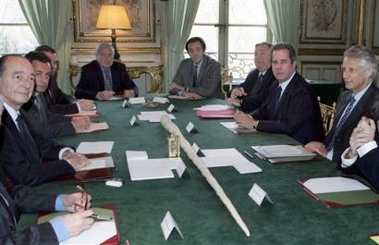
French President
Jacques Chirac, left, attends a meeting with French Interior Minister
Nicolas Sarkozy, second left, and Prime Minister Dominique de Villepin,
right, with other cabinet members, Monday April 10, 2006 in Paris.
Chirac's office said a new plan focusing on youths from troubled
backgrounds will replace the 'first job contract,' which would have made
it easier for employers to fire any worker under 26.
[AP] |
Unions declared victory, but energized students decided to go ahead with a
"day of action" Tuesday to try to knock down other measures ¡ª designed to reduce
the 22 percent unemployment rate among youths ¡ª that are viewed as threatening
coveted job protections.
In an announcement that amounted to a humiliating admission of defeat, Prime
Minister Dominique de Villepin said on nationwide TV that the contested measure
would be replaced.
Chirac had ordered the pullback after weighing the results of talks with
students and unions, the debilitating political fallout for the right and the
danger of increasingly daring student protests on railroad tracks and highways.
The announcement was a personal blow to Villepin, who was considered the
president's preferred successor for presidential elections next year. Villepin
designed the much maligned measure and had dug in his heels to save it.
"This sad adventure is an immense waste for our country," said Francois
Hollande, leader of the opposition Socialist Party, in one of many jibes at the
government.
Chirac said the measure would be replaced by one directed specifically at
disadvantaged youths, many of them living in housing projects in poor, mainly
immigrant suburbs. It would beef up measures already in place, rather than enact
new ones.
The government has brought overall unemployment down from 10.2 percent to 9.6
percent. But joblessness among the nation's youth stands at 22 percent, soaring
to nearly 50 percent in poor suburbs. Villepin looked to use the occasion to
start whittling at labor laws that prevent French companies from streamlining
and frighten some foreign firms from setting up shop here.
The rejected law would have allowed employers to fire workers under the age
of 26 at any time during a two-year trial period without giving a reason.
The government had said the law was aimed at spurring the hiring of youth.
Villepin had sought to add a dose of flexibility to France's rigid labor laws to
prime the French economy for the challenges of globalization.
The effort "was not understood by everyone. I express my regret," a humbled
Villepin said.
The crisis portrayed a government divided in a battle between the prime
minister and the ambitious Interior Minister Nicolas Sarkozy, who is openly
seeking the presidency. It also led to rumors that Villepin could resign and
suggestions that any presidential ambitions of his own were cut short.
In a TV interview Tuesday evening, the prime minister, calm and focused,
reiterated earlier denials that his goal was the presidency. But he showed no
sign of sinking into the shadows after being forced to abandon his jobs law.
"I have always said that I have no presidential ambitions," he said. He vowed
to "continue to fight, continue to produce answers, to draw lessons and perhaps
to come out with more experience."
Sarkozy, in a newspaper interview for publication Friday, made clear he was
among the law's doubters but pledged unity with the government.
With unions banding together against the law, "one can only question the
method and the fundamentals," Sarkozy said.
He said that as interior minister he had information showing that the protest
movement was radicalizing, and "that alerted and concerned me."
Anger over the law was deepened by Villepin's tactics: ramming the bill
through parliament with a special measure that does away with public debate.
The replacement bill was filed Monday at the National Assembly, the lower
chamber, and officials said debate might start as soon as Tuesday. In a
fast-track scenario, the four-point measure could be passed by both houses by
the end of the week, before parliament's spring recess.
The new bill would expand existing job contracts with the government, for
example, offering more state support for companies that hire young, less
qualified workers.
Other measures would increase internships in areas where jobs are relatively
plentiful ¡ª such as in restaurants, hotels, or hospitals for work as nurses ¡ª or
guide jobseekers in their careers.
Villepin drew up the contract as part of his response to last fall's wave of
rioting in France's impoverished suburbs, where many immigrants and their
French-born children live.
A meeting Monday of 12 worker and student unions said they would "remain
vigilant" until the new law was enacted.
France's most powerful union, the CGT, called the decision a "victory that
builds confidence" to resolve the jobs problem.
Students were wary, saying they would push hard for other changes.
"We want to see how we can take advantage of this power struggle that is now
in our favor to garner new victories," Bruno Julliard, the UNEF student
association leader, told AP Television News.