A robotic NASA spacecraft designed to rendezvous with an
orbiting satellite instead crashed into its target, according to a summary of
the investigation released Monday.
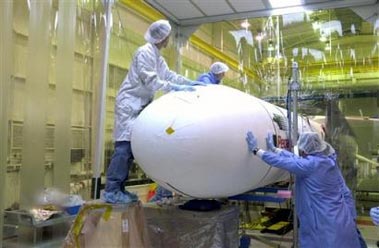
In this photo released by NASA, Orbital
Sciences Corp. technicians at Vandenberg Air Force Base, Calif., finish
installation of the fairing around the Demonstration of Autonomous
Rendezvous Technology (DART) spacecraft on Oct. 15, 2004. The NASA
spacecraft designed to autonomously carry out a series of tasks crashed
into its target after using too much fuel halfway through its mission,
according to a report summary released Monday, May 15, 2006. Investigators
blamed the collision on faulty navigational data that caused the DART
spacecraft to believe that it was backing away from its target when it was
actually bearing down on it. [AP Photo] |
Investigators blamed the collision on faulty navigational data that caused
the DART spacecraft to believe that it was backing away from its target when it
was actually bearing down on it.
"The inaccurate perception of its distance and speed ... prevented DART from
taking effective action to avoid a collision," the summary said.
The 800-pound Demonstration for Autonomous Rendezvous Technology spacecraft
was supposed to rendezvous with a defunct Pentagon satellite during a 24-hour
period last year.
DART successfully located the target satellite orbiting 472 miles above Earth
and moved within 300 feet of it. But problems arose when DART tried to circle
the satellite.
Investigators concluded that DART spent too much fuel steering itself toward
the satellite. The excessive firings of its engines were caused by inaccurate
navigational data from its on-board computer.
Determining that it wouldn't have enough reserve fuel to complete the
mission, DART began shutting down about 11 hours into the mission, but not
before crashing into the satellite.
Unbeknownst to engineers at the time, DART's main sensor mistakenly believed
it was flying away from the satellite when it was actually moving 5 feet per
second toward it, investigators found.
The collision pushed the target satellite into a higher orbit. NASA said
neither spacecraft pose a threat to other satellites and both will burn up upon
re-entry into the atmosphere.
In addition, the investigation also concluded that DART overestimated how
much fuel it consumed, although the remaining amount would not have been enough
to complete the mission.
Investigators also raised issues with the mission's management style, saying
that lack of training and experience caused the DART design team to shun expert
advice. They also found that internal checks and balances were inadequate in
uncovering the mission's shortcomings.
The 10-page document summarizing DART's failure comes a year after the
spacecraft was launched from Vandenberg Air Force Base in California.
Last month, NASA said it won't release the investigative board's full 70-page
report, citing sensitive information protected by International Traffic in Arms
Regulations. The summary was prepared by the space agency's exploration systems
mission directorate.
Robotic technology plays a critical role in NASA's plan to send humans back
to the moon and Mars. The $110 million DART mission was meant to test whether
robots can perform some of the tasks astronauts currently must do.
DART was managed by NASA's Marshall Space Flight Center in Huntsville, Ala.
It was built by Orbital Sciences Corp.
