|
Analysts question Israeli bombing of civilian targets
(AP)
Updated: 2006-07-20 11:06
DUBAI, United Arab Emirates - Thousands of Israeli bombs have fallen on
Lebanon's homes, roads, bridges, ports, broadcasting towers and even a
lighthouse.
Nearly 300 people, mainly civilians, have been killed in
Lebanon, the prime minister said Wednesday.
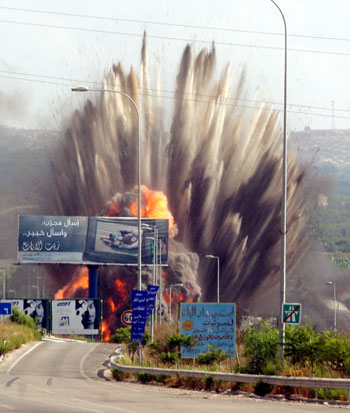
Debris flies after Israeli jets fired missiles
at the Zahrani bridge in south Lebanon July 14, 2006.
[Reuters] | Analysts say Israel's
targeting of civilian and government infrastructure overshadows its strikes on
the offices and rocket launchers of the Hezbollah guerrillas whose capture of
two Israeli soldiers triggered the attacks.
"This is a classic strategic
bombing campaign," said Stephen Biddle, a former head of military studies at the
U.S. Army War College, now at the Council on Foreign Relations. "What the
Israelis are trying to do is pressure others into solving their problem for
them. Hence the targeting of civilian infrastructure."
Israeli Cabinet
ministers have said the bombing aims to punish Lebanon and make the government
understand the entire country will suffer if Hezbollah isn't reined in.
But Israeli military spokesman Capt. Jacob Dallal said Wednesday that
Israel's bombing targets have direct military significance, since Hezbollah uses
roads to transport its rockets and stores them in houses.
"A lot of the
rockets are stored in people's homes in urban areas, fired from within villages
and brought in from the Damascus-Beirut highway," Dallal said. "We are in day
eight and the present condition of Hezbollah is unlike it was on day one.
There's no comparison, their infrastructure, their weaponry have all been
degraded considerably."
Classic strategic bombardment campaigns aim to
flatten economic key economic resources and are usually designed to bend the
targeted government to the will of its attacker or turn the populace against the
government.
The United States has been one of its chief proponents,
launching strategic bombing campaigns in Vietnam, Iraq and Serbia. In World War
II it targeted factories, railroads, bridges, ports and, in some cases,
residential neighborhoods.
But the growing list of civilian casualties -
despite Israel's use of U.S.-designed precision-guided bombs - could turn Arabs
and others against the Jewish state and its key American allies and still not
force Hezbollah Israel and its patron in Washington without fatally wounding
Hezbollah, said military analysts, including Anthony Cordesman of the Center for
Strategic and International Studies.
James Dobbins, a former Bush
administration envoy to Afghanistan who now heads military analysis for the Rand
Corp., said choice of targets was the key and may be misdirected in the current
Israeli campaign.
"The military rationale seems rather thin, since many
of the targets have no conceivable relationship to Hezbollah," he said.
Hezbollah has little visible presence and few links to Lebanon's
military. It is skilled at cloaking its actions from Israeli sensors, while its
primitive rockets - which have also killed innocents in Israel - are fired from
easy-to-hide mobile launchers. Their lack of a guidance system leaves them
without a traceable electronic signature, said Mustafa Alani, a military analyst
with Dubai-based Gulf Research Center.
"The Israelis face their classic
problem: They cannot punish Hezbollah, which has no physical structure to
destroy," Alani said.
Instead, Israel is bombing Hezbollah's Shiite
Muslim power base, leveling villages and office and apartment blocks in Shiite
neighborhoods in the eastern Bekaa Valley, southern Lebanon and south Beirut.
Dallal said the Israeli military bombs civilian buildings or homes if
intelligence points to a Hezbollah office or munitions on the site.
"If
there is a rocket stored in an apartment building and we attack the apartment in
the building in which it is stored," he said. "We have the right to attack
because of the missile."
The Brookings Institution's Michael O'Hanlon
said the Israeli campaign most closely resembles the U.S.-led NATO bombardment
of Serbia in 1999, in which a victory was achieved without a land invasion.
But the 78-day NATO bombardment of Serbia had clear international
legitimacy and was more gradual. Air crews targeted Serbian military and
communications sites first, and when that didn't persuade the Serb military to
pull out of Kosovo, planes hit civilian and government targets.
Targeting was far more discriminatory. Despite tens of thousands of
sorties, NATO is thought to have killed 500 civilians in the 2-1/2 month
campaign. By contrast, Israel has killed more than 250 Lebanese in eight days.
And the Serbian actions that triggered NATO's airstrikes were far larger
than anything launched from Lebanon, Dobbins said.
"The Serbian
government was responsible for the ethnic cleansing in Kosovo that drove a
million people from their homes," Dobbins said. "While the Lebanese government
is not responsible for the rocket attacks upon Israel."
The government,
however, has been unable to fulfill a U.N. directive that Hezbollah be disarmed
and that government forces take control of southern Lebanon from Hezbollah.
Israel has also chosen to hit targets that the United States would probably
reject, because of the danger of killing civilians, said Michele Flournoy, a
former Pentagon strategist now with CSIS.
U.S. war planners realize
their campaigns lose international and domestic support when innocents are
killed, Flournoy said.
"Our own population is very discriminating in the
use of force. People here have bought into the idea of proportionality and the
just war," Flournoy said.
For Israel, "it's a balancing act," Flournoy
said. "They want to use enough force to get through to the terrorists, while at
the same time staying within international norms, so as not to become a pariah."
Israel's history, however, has produced a defense posture that views its
enemies as fundamental and existential threats to the country's very survival.
"The airports and bridges don't belong to Hezbollah," Alani said.
"People may understand their (Israeli) reactions for the first few days. But
world leaders will soon say 'we don't see any links between your attacks and the
threat you face."'
|
| |
|
| |
|
|
|
| Most Commented/Read Stories in 48 Hours |
|
|
|
|
