Asia-Pacific
1st post-ban U.S. beef hits Japan
(AP)
Updated: 2006-08-08 10:43
 |
Large Medium Small |
TOKYO - Japan imported its first shipment of American beef since January on Monday, resuming a once-booming business that has been crippled for nearly three years over fears of mad cow disease.
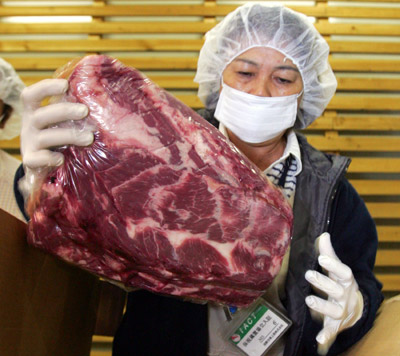 An official of the Agriculture Ministry checks packed beef imported from the U.S. at a storage room in the New Tokyo International Airport in Narita, east of Tokyo August 8, 2006. The first shipment of U.S. beef to Japan since Tokyo lifted a six-month-old ban on the American product last month arrived at Tokyo's Narita airport on Monday and will be allowed into the market if it meets requirements, government officials said.[Reuters] |
The 5.1 tons of American chilled beef arrived on a cargo flight at Narita airport, just east of Tokyo, and its importer and government officials were expected to inspect it on Tuesday, said Health Ministry official Masanori Imagawa.
Japan banned American beef in December 2003 after the first case of mad cow disease in the United States. That ban was eased in December 2005, but was reimposed after forbidden spine bones were found in an import shipment of veal in January.
Monday's shipment, which follows the latest easing of the beef ban on July 27, came from U.S. beef giant Cargill Inc. and was imported by Costco Wholesale Japan, the Japanese unit of the American retailer.
Costco employees, airport inspectors and Health Ministry officials were to scrutinize the entire shipment in a three-tiered process to make sure no banned products slip through, said Imagawa, who is in charge of customs and quarantine.
Previously, officials inspected only part of the shipments.
"We'll go through all boxes to make sure there is no problem, so inspection will probably take all day," Imagawa said.
Japan was a huge consumer of U.S. beef before December 2003, importing some US$1.4 billion worth and creating its most lucrative overseas market. Cheap and tasty, the meat was a favorite in ubiquitous beef and rice shops.
However, concerns over mad cow disease, known as bovine spongiform encephalopathy, or BSE, have severely damaged the Japanese faith in the safety of the imports. Those fears were compounded by the faulty shipment in January.
Recent public polls have showed the majority of Japanese consumers are planning to stay away from U.S. beef, and major restaurants and supermarkets have said they have no immediate plans to sell it.
"As imports have been resumed after sufficient safety considerations, it is now up to consumers to decide" whether to buy U.S. beef, Prime Minister Junichiro Koizumi told reporters.
Koizumi also urged the authorities to ensure safety inspections will be conducted properly.
"I won't eat it, no way," Reiko Iwai, a 57-year-old housewife, said while shopping at a downtown Tokyo supermarket. "I don't trust the safety of U.S. beef and its inspection process, especially after the repeated problems."
The reopening of the market followed a rigorous series of meetings, public hearings and inspections of American beef processing plants.
Japan so far has approved 33 of 35 such plants visited by government officials. One of the remaining two was deemed eligible for export, but only with follow-up surveillance. The approval for the other was pending.
On Monday, a Japanese inspection team was to leave for the U.S. to visit the two plants to evaluate their progress in the export program compliance.
Under the current agreement, all U.S. beef shipped to Japan must come from cattle aged 20 months or less, and no brain or spinal material can be included because it is considered at risk of carrying the disease.
U.S. officials have expressed interest in expanding the category of eligible beef to cattle aged 30 months or younger, since no cases of BSE have been discovered in cows that old, but Japan officials have rejected that for now.
BSE is a brain degenerative disease in cattle. In humans, eating meat contaminated with BSE is linked to variant Creutzfeldt-Jakob Disease, a rare and deadly nerve disease.
Not everyone in Japan, however, is afraid of eating American beef.
"I'd think it's safe enough if it passes inspection in Japan, so I'll eat it," said Yasutaka Kamikawa, a 29-year-old coffee shop employee. "I don't mind eating American beef as long as it's cheap and safe."