Asia-Pacific
Pakistani villagers fall prey to kidney trade
(Reuters)
Updated: 2006-08-11 09:56
 |
Large Medium Small |
BAHAWALPUR, Pakistan - Amjad Ali, a poor villager from the Cholistan Desert in eastern Pakistan, was promised a job and money in exchange for a kidney.
That was ten months ago. Now he's got no job, no money, and one kidney.
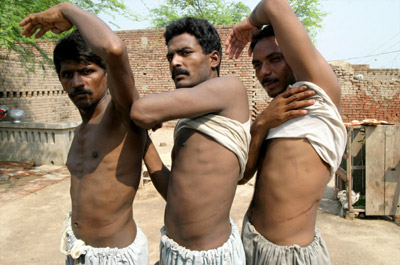 Mohammad Khalid (L), Mohammad Ijaz (C) and Liaqat show scars left on their bodies after they sold their kidneys in Bhalwal area of the Sargodha district July 10, 2006. Unlike many parts of the world, including neighbouring India, there is no law in Pakistan banning the trade in organs. Picture taken July 10, 2006.[Reuters] |
Slumped on a wooden cot in the compound of his spartan two-room house, Ali feels weak and is in constant discomfort as he tells an all too common story of how Pakistani organ traffickers prey on poor, ignorant peasants and workers.
"They promised me a job and took me to Rawalpindi. They drugged me, made me unconscious for days and cut out my kidney," Amjad said, his voice full of bitterness, as his father wept silently beside him.
Before an operation, donors are housed in the cities so that blood and tissue samples can be matched with potential recipients.
Unlike many other parts of the world, including neighbouring India, there is no law in Pakistan banning the trade in organs.
Sick, but wealthy Pakistanis, and foreigners from Saudi Arabia, the Gulf, Britain and Canada flock to private hospitals in Rawalpindi and Lahore for kidney transplants, made possible by donors' whose own post-operative welfare is callously neglected.
"We are taking this issue very seriously. A bill on it is with the national assembly and I think it should be tabled and approved in the next session, in August," minister of state for health, Shahnaz Sheikh, said.
Dr Adeeb Rizvi, a surgeon at a state-run hospital for Urology and Transplantation in the southern city of Karachi believes the post-operative neglect of donors is the most sickening aspect of the kidney trade.
"The issue is these people don't get proper post-operative medical care and their health suffers rapidly affecting their life," Rizvi said.
Defeated as he sounds, Ali wants the agents who lured him into losing a kidney to pay for ruining his life.
"I don't know what they did with my kidney, but I want justice or compensation," Ali said. His village Chak 45, in the sub-district of Yazman, is 27 kilometres (17 miles) from Bahawalpur in the south of Punjab province.
Ali's father has taken loans, sold his goats and crockery and even bricks to pay for his son's case to be brought to court.
Police have arrested three people for stealing Ali's kidney, but the suspects have documents to defend themselves.
"They have a stamp paper saying Amjad sold his kidney to them for 75,000 rupees ($1,250)," Rana Azam Khan, a senior police officer in Yazman, told Reuters.
"We know that poverty stricken people in Yazman sell their kidneys for money. But we get no complaints and there is no law under which we can take action against the middlemen or hospitals," Azam said with disgust.
There have been attempts to introduce legislation before, but they came to naught.
The victims of this grisly trade come from rural areas where feudalism still prevails and it is often in the landlords' interests to have debt-ridden peasants.
In Madina, a village set among orange groves near Sargodha town in central Punjab, three friends -- Mohammad Khalid, Liaquat Ali and Mohammad Tariq -- display almost identical eight-inch scars to the side of their abdomen.
All three sold kidneys to escape debt. They are still in debt.
They earn 100 rupees (less than $2) a day working in an orange packing plant or for the local landlord.
"People in this area sell kidneys because of poverty. They do it for their loved ones," Tariq said, as the men sat crouched in a small mud house that stank of cow dung.
The sunken eyes and hollowed cheeks of his friend Khalid reflected the worries and sickness gnawing at his insides.
"I owed 55,000 rupees (over $900) to the plant owner. I spent the money on treatment of my child. I have six children and I have accumulated more debts as I can't work as much as I used to," Khalid said, adding that he would never advise anyone to do what he did.
A female relative, Rehana, who witnessed Khalid's plight was determined her husband Arif should not go down the same path.
So she sold her kidney instead of him.
"My husband has to do hard labour. I only work in the house, I knew it was better for me to sell my kidney," Rehana said.
Church worker Elder Pervaz, from a predominantly Christian neighbourhood of Faisalabad city, launched a campaign to alert people against agents harvesting organs from vulnerable victims.
"We had seven cases of people selling their kidneys. And when our area became known as "kidney colony" the church realised it had to do something," Pervaz said.
The claustrophobic narrow lanes of Madina are dotted with puddles of open sewage.
"When you look at our living conditions, you can understand why people fell into this trap," he said, his arm sweeping round Faisalabad's depressing Dawood housing colony.