BAGHDAD, Iraq - In the few short years since the first shackled Afghan
shuffled off to Guantanamo, the US military has created a global network of
overseas prisons, its islands of high security keeping 14,000 detainees beyond
the reach of established law.
Disclosures of torture and long-term arbitrary detentions have won rebuke
from leading voices including the UN secretary-general and the US Supreme Court.
But the bitterest words come from inside the system, the size of several major
US penitentiaries.
|
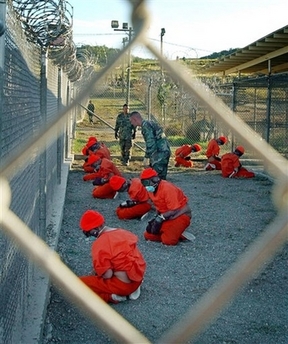
In this Jan. 11, 2002 file photo released by
the US Navy, detainees in orange jump suits sit in a holding area under
the watchful eyes of military police at Camp X-Ray at Naval Base
Guantanamo Bay, Cuba, during in-processing to the temporary detention
facility. In the few short years since the first shackled Afghan shuffled
off to Guantanamo, the US military has created a global network of
overseas prisons, its islands of high security keeping 14,000 detainees
beyond the reach of established law.
[AP]
|
"It was hard to believe I'd get out," Baghdad shopkeeper Amjad Qassim
al-Aliyawi told The Associated Press after his release - without
charge - last month. "I lived with the Americans for one year and eight
months as if I was living in hell."
Captured on battlefields, pulled from beds at midnight, grabbed off streets
as suspected insurgents, tens of thousands now have passed through US detention,
the vast majority in Iraq.
Many say they were caught up in US military sweeps, often interrogated around
the clock, then released months or years later without apology, compensation or
any word on why they were taken. Seventy to 90 percent of the Iraq detentions in
2003 were "mistakes," US officers once told the international Red Cross.
Defenders of the system, which has only grown since soldiers' photos of abuse
at Abu Ghraib shocked the world, say it's an unfortunate necessity in the
battles to pacify Iraq and Afghanistan, and to keep suspected terrorists out of
action.
Every US detainee in Iraq "is detained because he poses a security threat to
the government of Iraq, the people of Iraq or coalition forces," said US Army
Lt. Col. Keir-Kevin Curry, a spokesman for US-led military detainee operations
in Iraq.
But dozens of ex-detainees, government ministers, lawmakers, human rights
activists, lawyers and scholars in Iraq, Afghanistan and the United States said
the detention system often is unjust and hurts the war on terror by inflaming
anti-Americanism in Iraq and elsewhere.
Building for the Long Term
Reports of extreme physical and mental abuse, symbolized by the notorious Abu
Ghraib prison photos of 2004, have abated as the Pentagon has rejected
torture-like treatment of the inmates. Most recently, on Sept. 6, the Pentagon
issued a new interrogation manual banning forced nakedness, hooding, stress
positions and other abusive techniques.
The same day, President Bush said the CIA's secret outposts in the prison
network had been emptied, and 14 terror suspects from them sent to Guantanamo
Bay, Cuba, to face trial in military tribunals. The US Supreme Court has struck
down the tribunal system, however, and the White House and Congress are now
wrestling over the legal structure of such trials.
Living conditions for detainees may be improving as well. The US military
cites the toilets of Bagram, Afghanistan: In a cavernous old building at that
air base, hundreds of detainees in their communal cages now have indoor plumbing
and privacy screens, instead of exposed chamber pots.
Whatever the progress, small or significant, grim realities persist.
Human rights groups count dozens of detainee deaths for which no one has been
punished or that were never explained. The secret prisons - unknown in
number and location - remain available for future detainees. The new manual
banning torture doesn't cover CIA interrogators. And thousands of people still
languish in a limbo, deprived of one of common law's oldest rights, habeas
corpus, the right to know why you are imprisoned.

