American Edmund S. Phelps won the 2006 Nobel Memorial Prize in Economic
Sciences on Monday for furthering the understanding of the trade-offs between
inflation and its effects on unemployment.
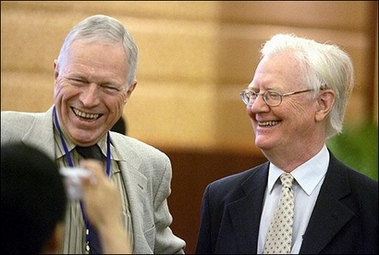
Edmund S.Phelps (L) and James Mirrlees laugh
as they pose for a photo at the Nobel Laureates Forum 2005, in Beijing,
May 2005. Phelps has won the 2006 Nobel Economics Prize for work on
trade-offs in macroeconomic policy, the Nobel jury said, noting that his
work had improved understanding of how policy affected welfare for present
and future generations.[AFP] |
The 73-year-old
Columbia University professor's work showed how low inflation today leads to
expectations of low inflation in the future, thereby influencing future policy
decision making by corporate and government leaders.
Phelps is the sixth American to win a Nobel this year, meaning that every
prize except for the literature and peace awards, which are yet to be announced,
have gone to Americans.
"It's beginning to sink in that I have won this wonderful award," Phelps said
from New York in a live telephone conference with reporters in the Swedish
capital. "I understood that it could happen, but I had no idea when it would
happen or if it would happen.
"I tried to put the people back into our economic model and in particular to
take into account their expectations about what other economic actors are doing
at the same time and in the future," he said.
The Royal Swedish Academy of Sciences said Phelps' work, done in the late
1960s, had "deepened our understanding of the relation between short-run and
long-run effects of economic policy."
Phelps challenged the prevailing view in the 1960s that there was a stable,
negative relationship between inflation and unemployment, illustrated by the
so-called Phillips curve.
"He recognized that inflation does not only depend on unemployment, but also
on the expectations of firms and employees about price and wage increases," the
academy said.
Phelps put together a new model to describe the relationship between
inflation and unemployment, known as the expectations-augmented Phillips curve.
He also showed that there is a precise "equilibrium unemployment rate" at
which firms raise workers' wages at the same rate as average wages are expected
to rise in the economy overall. Those findings have influenced central banks in
their interest-rate decisions, the academy said.
"Phelps' work has fundamentally altered our views on how the macroeconomy
operates," the citation said, adding his work proved fruitful in understanding
the causes of the increases in both inflation and unemployment in the 1970s.
In its citation announcing the award, the academy said that Phelps had
advanced the understanding of the trade-offs between full employment, stable
pricing and rapid growth, all of which are the central goals of any sound
economic policy.
"But policy always faces difficult goal conflicts. How should inflation and
unemployment be balanced against each other?" the academy asked in the citation.
"What trade off should be made between the consumption of current and future
generations?"
Phelps' work advanced the understanding of those trade-offs.
"He has emphasized that not only the issue of savings and capital formation
but also the balance between inflation and unemployment are fundamentally issues
about the distribution of welfare over time," the academy said. "Phelps'
analyses have had a profound impact on economic theory as well as on
macroeconomic policy."
Phelps also pioneered the analysis of the importance of human capital, or
workers themselves, for the diffusion of new technology and growth in the
business and corporate world, the academy said in its citation.
Previous winners of the economics prize, given out since 1969, ranged from
how the control of information affects markets to welfare economics used to
explain the economic mechanisms that underlie famine and poverty.
Last year's winners were Robert J. Aumann, a citizen of Israel and the United
States, and American Thomas C. Schelling, for their work in game-theory
analysis.
The economics prize, worth $1.4 million, is the only one of the awards not
established in the will left by Swedish industrialist Alfred Nobel 111 years
ago.
The medicine, physics, chemistry, literature and peace prizes were first
awarded in 1901, while the economics prize was set up separately by the Swedish
central bank in 1968.
The economics prize is the fourth of six to be announced. The winner of the
Nobel Prize in literature will be announced Thursday, followed by the Nobel
Peace Prize in Oslo, Norway, on Friday.
Last week, the Nobel medicine prize went to Andrew Z. Fire and Craig C. Mello
for discovering a powerful way to turn off the effect of specific genes. John C.
Mather and George F. Smoot won the physics prize for work that helped cement the
big-bang theory of how the universe was created.
American Roger D. Kornberg won the prize in chemistry for his studies of how
cells take information from genes to produce proteins, a process that could
provide insight into defeating cancer and advancing stem cell research.
The Nobel prizes are presented Dec. 10, the anniversary of the death of their
founder. The peace prize is awarded in Oslo, Norway, and the other Nobel prizes
are presented in Stockholm.
