Germans speak about secret Nazi program
(AP)Updated: 2006-11-05 09:05
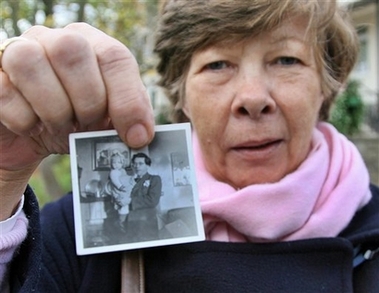 German Violetta Wallenborn presents a photo of herself in the arms of her father during a visit to the former Lebensborn home 'Harz' in Wernigerode, eastern Germany, Saturday, Nov. 4, 2006. She was born as one of the so-called Lebensborn children in a home in Norway. A group of Germans who as children were selected by the Nazis for their Aryan qualities as part of Adolf Hitler's quest to build a master race were gathering publicly Saturday for the first time to discuss the secretive program. (AP)  |
WERNIGERODE, Germany - Folker Heinicke always had the feeling that something about his upbringing just wasn't right.
Raised in a German home full of wealth and privilege did not dull his notions that something was missing, but it would be decades before he would learn the full truth: he was the child of a Nazi program to strengthen the German race with Aryan blood.
He and other children ¡ª known as "Lebensborn Kinder" or "source of life" kids ¡ª were the product of parents chosen for their traits to breed Hitler's idealized blue-eyed, blonde-haired Aryan race.
For the last four years, Heinicke and about 40 other children raised in the Nazi program have met to support each other. On Saturday for the first time, they told their stories in public, swapping tales of aunts who turned out to be mothers, ice-cold adoptive parents who slid into alcoholism and the joy at finding a blood relative who embraced them as a member of their family.
"There was always the feeling that something wasn't quite right," said Heinicke, who was stolen from present-day Ukraine by the Nazis. "It happens when you have no mother, no father, no roots."
Heinicke's parents told him when he was a teenager that he was adopted but did not reveal the full truth about his background. Later in life, he started exploring irregularities in his birth certificate that led him to other questions, eventually uncovering that he had passed through a Lebensborn home. He discovered his true identity but has yet to find any of his relatives.
Others like Heinicke were born outside the program and taken as toddlers from parents in lands the Germans overran during World War II, then given to a German family to raise.
The Lebensborn program was the mirror opposite of the Nazi's other, more hideous racial experiments.
While millions of Jews and others deemed "undesirable," were slaughtered, these children were carefully selected for their Aryan qualities and brought into the world in comfortable surroundings, well away from the Allied bombing raids.
Of the estimated 5,000 to 8,000 born into Lebensborn homes in Germany, some were raised by their birth mothers, but many were given over to families of high-ranking SS officers to be raised according to Nazi doctrine.
The group is seeking to correct what they say are historical misconceptions that the Lebensborn program was nothing more than a high-class bordello offering up blue-eyed blondes to SS officers as a means to breed a "perfect" race.
"We need to find the courage to speak out in public, to tell our stories as long, as long as we are still alive," urged Violette Wallenborn, whose mother was a Norwegian singer and father a Nazi choir director.
Previous meetings have focused on support and swapping tips on how to track down still-living relatives. But telling their stories is increasingly becoming an aim of members of the association called Lebenssupren, or "Tracing Life."
Because 60 percent of the women who gave birth in Lebensborn homes were not married ¡ª a stigma in those conservative times ¡ª the births were kept secret. In the final days of the war, the Nazis destroyed many documents detailing the births in hopes of covering their tracks.
Gisela Heidenreich, the daughter of a German secretary and an SS commander, stressed the importance of telling the Lebensborn stories in schools.
"Pupils today know all the facts, their historical knowledge is very good, but they don't have any emotional relationship to it," she said. "The story of Lebensborn is so important because it's about families; mothers, fathers, children, it's something they can relate to."
In some cases, the kids in the program were housed outside of Germany.
After the Nazis overran Germany's neighbor states in 1940, German occupation soldiers were encouraged to find suitable local mates. Ten Lebensborn homes were set up in foreign lands, where some 8,000 children were eventually born.
Two years later, the Nazis began seeking out blue-eyed, blonde-haired children in neighboring, mostly Slavic, countries and sending them back home to be "Germanized," as Heinicke was.
Hans-Ullrich Wesch, 64, was born in a Lebensborn home in a leafy residential area of Wernigerode in the former East Germany. There, the secret police prevented him from finding his true parents.
Only after the Berlin Wall fell could he track down his birth mother.
"I am one heart and one soul with my mother," said Wesch, who found her several years ago. "She was very, very pleased when she found me. She suffered a lot as well."
|
||
|
||
|
|