Attack on Baghdad Shiite slum kills 161
(AP)Updated: 2006-11-24 07:34
|
|
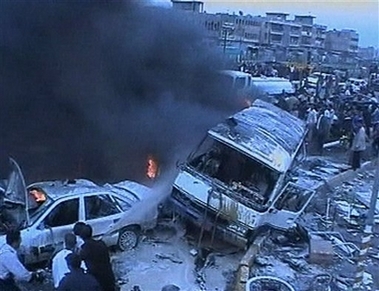

BAGHDAD, Iraq - Sunni Muslim insurgents blew up five car bombs and fired mortars into Baghdad's largest Shiite district Thursday, killing at least 161 people and wounding 257 in a dramatic attack that sent the US ambassador racing to meet with Iraqi leaders in an effort to contain the growing sectarian war.


Two other mortar barrages on Sunni neighborhoods in west Baghdad killed nine and wounded 21, police said late Thursday.
The bloodshed underlined the impotence of the Iraqi army and police to quell determined sectarian extremists at a time when the Bush administration appears to be considering a move to accelerate the hand-over of security responsibilities. President Bush plans to visit the region next week to discuss the security situation with Iraqi Prime Minister Nouri al-Maliki.
"We condemn such acts of senseless violence that are clearly aimed at undermining the Iraqi people's hopes for a peaceful and stable Iraq," said Jeanie Mamo, a White House spokeswoman.
Iraq's government imposed a curfew in the capital and also closed the international airport. The transport ministry then took the highly unusual step of closing the airport and docks in the southern city of Basra, the country's main outlet to the vital shipping lanes in the Persian Gulf.
Leaders from Iraq's Shiite, Sunni and Kurdish communities issued a televised appeal for calm after a hastily organized meeting with U.S. Ambassador Zalmay Khalilzad. The US Embassy said it had nothing to report about the session.
Al-Maliki, a Shiite, also went on state TV and blamed Sunni radicals and followers of Saddam Hussein for the attacks on Sadr City.
The coordinated car bombings - three by suicide drivers and two of parked cars - billowed black smoke up into clouds hanging low over blood-smeared streets jammed with twisted and charred cars and buses.
Hospital corridors and waiting rooms were awash in blood and mangled survivors of bombs that struck at 15-minute intervals in the sprawling Shiite slum, which is a stronghold of the Mahdi Army militia of radical anti-American cleric Muqtada al-Sadr, a key al-Maliki backer.
The militia and associated death squads are believed responsible for the slayings of hundreds of Sunnis since suspected al-Qaida in Iraq militants bombed a revered Shiite shrine in the city of Samarra last February.
That attack set off a surge of retaliatory killings between Shiites and Sunnis that have raged all year.
Al-Sadr associates, speaking to The Associated Press on condition of anonymity because of the sensitive nature of the information, said the cleric feared that the Sadr City bombings would make it impossible for him to hold back his heavily armed fighters from a furious round of revenge attacks.
In a television statement read by an aide, al-Sadr urged unity among his followers to end the U.S. "occupation" that he said is causing Iraq's strife. Al-Sadr said the attacks coincided with the seventh anniversary of the assassination of his father, Mohammed Sadiq al-Sadr, a revered Shiite religious leader. The anniversary reckoning was by the Islamic calendar.
"Had the late al-Sadr been among you he would have said preserve your unity," the statement said. "Don't carry out any act before you ask the Hawza (Shiite seminary in Najaf). Be the ones who are unjustly treated and not the ones who treat others unjustly."
Grand Ayatollah Ali al-Sistani, the pre-eminent Shiite religious figure in Iraq, condemned the bombings and issued condolences to family members of those who were killed. He called for self-control among his followers.
Iraq is suffering through a period of unparalleled violence. The United Nations said Wednesday that 3,709 Iraqi civilians were killed in October, the most in any month since the war began 44 months ago, and a figure certain to be eclipsed in November.
The Sadr City slaughter occurred just moments after US helicopters and Iraqi armor had to intervene to stop an attack by 30 masked Sunni gunmen who tried to storm the Shiite-dominated Health Ministry, about a mile west of the Shiite slum. Seven ministry guards were wounded.
Residents also reported heavy mortar fire and gunbattles in Hurriyah, a now-largely Shiite neighborhood in northwest Baghdad. There were pitched battles between gunmen and the army on Haifa Street, a dangerous thoroughfare running north from the Green Zone, site of the American and British embassies as well as the Iraqi government and parliament.
Iraqis also reported heavy fighting around the Jadriyah Bridge near Baghdad University and AP personnel saw 12 pickup trucks loaded with men armed with rocket-propelled grenade launchers and heavy machine guns driving through the center of the city.
Counting those killed in Sadr City, at least 233 people died or were found dead across Iraq on Thursday.
Before dawn Thursday, US and Iraqi forces searching for a kidnapped American soldier swept through an area of Sadr City, killing four Iraqis, wounding eight and detaining five, police said.
The raid was the fourth time in six days that coalition forces raided the district looking for US soldier Ahmed Qusai al-Taayie, a 41-year-old Ann Arbor, Mich., resident who was snatched from the street while he was visiting his Iraqi wife in Baghdad on Oct. 23.
The Mahdi Army is believed to have grabbed al-Taayie as well as dozens of people during a raid on a Ministry of Higher Education office in Baghdad on Nov. 14. The ministry is predominantly Sunni Arab.
During the 4:30 a.m. raid coalition forces searched houses and opened fire on a minivan carrying Iraqi workers in al-Fallah Street, killing four and wounding eight, said police Capt. Mohammed Ismail. He said coalition forces also detained five Iraqis.
In a statement, the US military confirmed the raid and said it was part of the effort to find al-Taayie. It confirmed the detention of five Iraqis and said a vehicle was shot at by Iraqi troops after "displaying hostile intent." The statement did not report Iraqi casualties.
The military also reported that three Marines were killed during combat in Anbar province, where many Sunni-Arab insurgents are based. That raised the US death toll so far this month to 52.
|
||
|
||
|
|