Reports: Bush to replace top generals
(AP)Updated: 2007-01-05 16:48
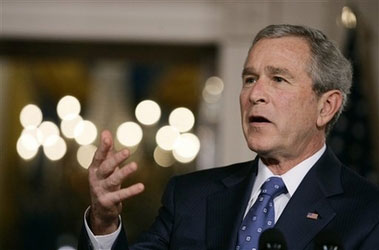 US President Bush speaks while making statements to reporters with German Chancellor Angela Merkel, not pictured, in the Cross Hall of the White House in Washington January 4, 2007. [AP]  |


Bush wants to replace Abizaid with Adm. William Fallon, the top US commander in the Pacific, and Casey's replacement will be Army Lt. Gen. David Petraeus, who headed the effort to train Iraqi security forces, the reports citing administration officials said.
Giving Fallon and Petraeus the top military posts in the Middle East would help Bush to assert that he is taking a fresh approach in the region and help pave the way for him to turn policy there in a new direction. Both Abizaid and Casey have expressed reservations about the potential effectiveness of boosting troop strength in Iraq.
Sen. Daniel K. Inouye, the ranking Democrat on the Senate Defense appropriations subcommittee, told The Associated Press on Thursday that he understands Bush wants to appoint Fallon to head the US Central Command, a position responsible for directing the wars in both Iraq and Afghanistan.
"He's highly knowledgeable and well-educated and respected," Inouye said of Fallon. "I would think that his nomination, if the president is to submit it, would go flying through."
In a news conference Thursday, Bush said that he would go before the nation next week with his long-anticipated speech about the next steps in Iraq. The war was a major factor in the Republicans' loss of Congress and Bush's slide in the polls. More than 3,000 members of the US military have lost their lives in the war.
"I'll be ready to outline a strategy that will help the Iraqis achieve the objective of a country that can govern, sustain and defend itself sometime next week," the president said. "I've still got consultations to go through." Some members of Congress have been invited to the White House on Friday for discussions about Iraq.
Considering more troops to deal with the rising violence in Baghdad, Bush said, "One thing is for certain: I will want to make sure the mission is clear and specific and can be accomplished." Senior generals have cautioned against sending additional troops unless their role is defined.
Abizaid and Casey have at times sounded skeptical about increasing the size of the US force in Iraq.
In November, Abizaid told the Senate Armed Services Committee that boosting the roughly 140,000 US troops in Iraq by 20,000 would have a temporary impact, but he warned that the military's ability to maintain in increase of that size "is simply not something that we have right now."
Casey told reporters in Iraq last month that he is "not necessarily opposed to the idea" of sending in more troops, but said any increase would have to "help us progress to our strategic objectives."
Along with changes in policy in Iraq, Bush is rearranging his national security team. Retired Vice Adm. Mike McConnell, a veteran of more than 25 years in the intelligence field, will be named Friday to succeed John Negroponte as national intelligence director, officials said.
In addition, Zalmay Khalilzad, the US ambassador to Iraq, will be nominated to become the US envoy to the United Nations, according to a senior Bush administration official. He is likely to be replaced in Baghdad by Ryan Crocker, a veteran American diplomat now US envoy to Pakistan.
Bush's new plan for Iraq is expected to contain economic, political and diplomatic components.
Given the need to reduce high unemployment and draw Iraqis away from Shiite militias and the Sunni insurgency, the president is considering loans to businesses. He is looking at getting Iraqis into short-term jobs by proposing a significant increase in the discretionary funds that military commanders can use for reconstruction projects.
Questions about what the president's plan will mean for the US military presence in Iraq have gotten the most attention.
One option presented to Bush calls for an initial infusion of 8,000 to 9,000 troops, mainly to reinforce Baghdad. The option involves sending two additional Army brigades, or roughly 7,000 soldiers, to Baghdad, and two Marine battalions, totaling about 1,500 troops, to western Anbar Province, the center of the Sunni Arab insurgency.
Sen. Ben Nelson , a member of the Armed Services Committee, was one of those asked to Friday's meeting at the White House. Nelson, D-Neb., said he planned to urge the president to resist sending more troops without setting firm conditions.
Bush and Prime Minister Nouri al-Maliki spoke on a secure video hookup for nearly two hours Thursday. He appeared later in the day with German Chancellor Angela Merkel and recounted some of his discussions with al-Maliki.
The president said he talked with the prime minister about the final moments of Saddam's life, when he was taunted before being hanged. An unauthorized video showed images of Saddam's dangling body. The White House has been reluctant to criticize the proceedings, which have been condemned by some world leaders as deplorable.
"My personal reaction is that Saddam Hussein was given a trial that he was unwilling to give the thousands of people he killed," Bush said. "I wish, obviously, that the proceedings had gone on in a more dignified way."
|
||
|
||
|
|