Bush takes blame in Iraq, adds troops
(AP)Updated: 2007-01-11 10:18
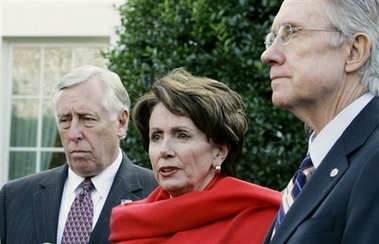 Democratic leaders, from left, House Majority Leader Steny Hoyer of Md., House Speaker Nancy Pelosi of Calif., and Senate Majority Leader Harry Reid of Nev. talk to reporters outside the White House in Washington, Wednesday, Jan. 10, 2007, following a meeting with President Bush to discuss his revised Iraq strategy. [AP]  |
"Where mistakes have been made, the responsibility rests with me," Bush said.


In a prime-time address to the nation, Bush pushed back against the Democrats' calls to end the unpopular war. He said that "to step back now would force a collapse of the Iraqi government, tear that country apart and result in mass killings on an unimaginable scale."
"If we increase our support at this crucial moment and help the Iraqis break the current cycle of violence, we can hasten the day our troops begin coming home," he said.
In addition to extra US forces, the plan envisions Iraq committing 10,000 to 12,000 more troops to secure Baghdad's neighborhoods.
Even before Bush's address, the new Democratic leaders of Congress renewed their opposition to a buildup. "This is the third time we are going down this path. Two times this has not worked," House Speaker Nancy Pelosi, D-Calif., said after meeting with the president. "Why are they doing this now? That question remains."
Senate and House Democrats are arranging votes urging the president not to send more troops. While lacking the force of law, the measures would compel Republicans to go on record as either bucking the president or supporting an escalation.
Usually loath to admit error, Bush said it also was a mistake to have allowed American forces to be restricted by the Iraqi government, which tried to prevent US military operations against fighters controlled by the radical Shiite cleric Muqtada al-Sadr, a powerful political ally of Prime Minister Nouri al-Maliki. The president said al-Maliki had assured him that "political or sectarian interference will not be tolerated."
After nearly four years of bloody combat, the speech was perhaps Bush's last credible chance to try to present a winning strategy in Iraq and persuade Americans to change their minds about the unpopular war, which has cost the lives of more than 3,000 members of the US military as well as more than $400 billion.
Bush's approach amounts to a huge gamble on al-Maliki's willingness - and ability - to deliver on promises he has consistently failed to keep: to disband Shiite militias, pursue national reconciliation and make good on commitments for Iraqi forces to handle security operations in Baghdad.
"Our past efforts to secure Baghdad failed for two principal reasons: There were not enough Iraqi and American troops to secure neighborhoods that had been cleared of terrorists and insurgents," the president said. "And there were too many restrictions on the troops we did have."
He said American commanders have reviewed the Iraqi plan "to ensure that it addressed these mistakes."
Bush said that under his plan, US forces will work alongside Iraqi units and be embedded in their formations.
Responding to concerns from US commanders, Bush said American troops will have a clearly defined mission to help Iraqis clear and secure neighborhoods, assist in the protection of the local population and "to help ensure that the Iraqi forces left behind are capable of providing the security that Baghdad needs."
While Bush is putting the onus on the Iraqis to meet their responsibilities and commit more troops, Bush did not threaten specific consequences if they do not. Iraq has missed previous self-imposed timetables for taking over security responsibilities.
Bush, however, cited the government's latest optimistic estimate. "To establish its authority, the Iraqi government plans to take responsibility for security in all of Iraq's provinces by November," the president said.
Resisting calls for troop reductions, Bush said that "failure in Iraq would be a disaster for the United States. A democratic Iraq will not be perfect. But it will be a country that fights terrorists instead of harboring them."
But Bush warned that the strategy would, in a short term he did not define, bring more violence rather than less.
"Even if our new strategy works exactly as planned, deadly acts of violence will continue, and we must expect more Iraqi and American casualties," he said. "The question is whether our new strategy will bring us closer to success. I believe that it will."
Bush's warning was echoed by Sen. John McCain, R-Ariz., a leading proponent of a troop increase. "Is it going to be a strain on the military? Absolutely. Casualties are going to go up," the senator said.
Bush said he considered calls from Democrats and some Republicans to pull back American forces. He concluded it would rip Iraq apart.
"Such a scenario would result in our troops being forced to stay even longer and confront an enemy that is even more lethal," the president said. "If we increase our support at this crucial moment and help the Iraqis break the current cycle of violence, we can hasten the day our troops begin coming home."
Still, Bush said that "America's commitment is not open-ended. If the Iraqi government does not follow through on its promises, it will lose the support of the American people and it will lose the support of the Iraqi people. Now is the time to act."
The buildup comes two months after elections that were widely seen as a call for the withdrawal of some or all US forces from Iraq. Polling by AP-Ipsos in December found that only 27 percent of Americans approved of Bush's handling of Iraq, his lowest rating yet.
Bush's blueprint would boost the number of US troops in Iraq - now at 132,000 - to 153,500 at a cost of $5.6 billion. The highest number was 160,000 a year ago in a troop buildup for Iraqi elections.
The latest increase calls for sending 17,500 US combat troops to Baghdad. The first of five brigades will arrive by next Monday. The next would arrive by Feb. 15 and the reminder would come in 30-day increments.
Bush also committed 4,000 more Marines to Anbar Province, a base of the Sunni insurgency and foreign al-Qaida fighters.
Bush's plan mirrored earlier moves attempting to give Iraqi forces a bigger security role. The chief difference appeared to be a recognition that the Iraqis need more time to take on the full security burden.
Another difference involves doubling the number of US civilian workers who help coordinate local reconstruction projects. These State Department-led units - dubbed Provincial Reconstruction Teams - are to focus on projects both inside and outside the heavily guarded Green Zone, and some will be merged into combat brigades.
Several Republican senators are candidates for backing the resolution against a troop increase. Sens. Susan Collins and Olympia Snowe of Maine, Gordon Smith of Oregon and Norm Coleman of Minnesota said they oppose sending more soldiers.
Republican Sens. George Voinovich of Ohio and John Warner of Virginia also might be persuaded. Warner said he supports the Iraq Study Group recommendations, which strongly cautioned against an increase in troops unless advocated by military commanders.
Bush's strategy ignores key recommendations of the Iraq Study Group, which in December called for a new diplomatic offensive and an outreach to Syria and Iran.
| ||
|
||
|
||
|
|