Senate GOP foils debate on Iraq surge
(AP)Updated: 2007-02-18 10:12
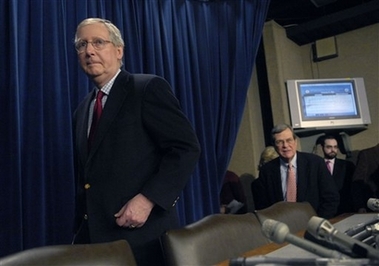 Senate Minority Leader Sen. Mitch McConnell, R-Ky., arrives for a news conference in the Capitol in Washington Saturday, Feb. 17, 2007 after Republicans blocked a Democratic effort to pass a nonbinding resolution rebuking President Bush's deployment of additional combat troops to Iraq. McConnell is followed by Sen. Trent Lott, R-Miss. [AP]  |
WASHINGTON - The US Senate gridlocked on the Iraq war in a sharply worded showdown Saturday as Republicans foiled a Democratic bid to repudiate President Bush's deployment of 21,500 additional combat troops.

Democrats swiftly claimed victory. "A majority of the United States Senate is against the escalation in Iraq," said Majority Leader Harry Reid of Nevada. "As for the Republicans who chose once again to block further debate and protect President Bush, the American people now know they support the escalation" in troops.
Republicans blasted the Democratic leadership for refusing to allow a vote on an alternative that ruled out any reduction in money for troops in the field.
"There is no place for chicanery at a time of war," said Senate GOP leader Mitch McConnell of Kentucky. "Even some of the president's most strident opponents know that. They know that the only vote that truly matters is a vote on whether to fund the troops."
The White House echoed his remarks, issuing a written statement that touched lightly on the votes in the House and Senate, and looked to the coming debate over Bush's request for an additional $93 billion for the military.
"This week's voting gave the world a glimpse of democracy's vigor. The next votes should provide unmistakable assurance of this nation's resolve in achieving success, supporting the cause of democracy and stopping terrorist forces in their ultimate aim of bringing their violence to our shores," said the statement, issued in the name of press secretary Tony Snow.
The day's events ended the initial phase of what looms as a yearlong confrontation between the new, Democratic-controlled Congress and the commander in chief.
Reid told reporters he would no longer attempt to win passage for nonbinding measures and would turn his attention to legislation designed to force Bush to change course. House Democratic leaders intend to do likewise.
Saturday's maneuvering occurred in an intensely political environment, both in and out of the Capitol.
The unusual weekend session sent presidential contenders in both parties scrambling to make the roll call.
One of them, Democratic Sen. Hillary Rodham Clinton of New York, squeezed in a morning appearance in New Hampshire, where she told one audience, "We have to end this war and we can't do it without Republican votes."
Nine Republicans skipped the Senate session, calculating that because they support Bush's policies, their votes would not affect the outcome of the vote.
Among them was Sen. John McCain of Arizona, a presidential hopeful who campaigned in Iowa. He called the Senate vote meaningless, and told one audience the symbolic measures are "insulting to the public and the soldiers."
At least two Republican lawmakers chose to leave on an official trip to Iraq rather than remain behind for the vote.
The nonbinding measure consisted of fewer than 100 words. It disapproved of Bush's decision to deploy more troops and pledged to support and protect the troops in the field.
Even before the House acted, Bush had made it clear that congressional opposition would not deter him from proceeding with the deployment of another 21,500 troops, designed primarily to quell sectarian violence in heavily populated Baghdad.
Already, troops of the Army's 82nd Airborne have arrived in Iraq. Another brigade is in Kuwait, in final training before going to Iraq. Three more brigades are ticketed for the Baghdad area, one each in March, April and May.
In addition, the Pentagon is sending two Marine battalions to Anbar province in the western part of the country, the heart of the Sunni insurgency.
Polls show strong public opposition to the war, which has killed more than 3,100 U.S. troops. Tens of thousands of Iraqis have died, the majority of them since Saddam Hussein was toppled from power in the U.S.-led invasion in March 2003.
Democrats seemed eager to force Republicans into votes that might prove politically troublesome.
"They are torn between their president's policy and the wishes of the constituents, but vote they must," said Sen. Charles Schumer of New York, head of the Senate Democrats' campaign committee.
But Sen. Lindsey Graham, R-S.C., said Democrats, too, were caught in a political squeeze play. He said the alternative measure pledging not to cut off funds for the troops would have drawn as many as 75 votes, but accused Reid of blocking it to protect his rank and file.
"If you have this vote, the left, the radical Democratic left, would eat every Democratic presidential candidate alive," Graham said.
Democrats in both the House and Senate have said the nonbinding measures would be only the first attempt to force a shift in Bush's war policies.
In the Senate, Reid has told lawmakers he will turn anti-terrorism legislation into a forum for debate over the war. He has met privately in recent days with fellow Democrats as the leadership plans its next move.
"The Senate will keep fighting to force President Bush to change course," Reid said at a news conference after the vote.
In the House, Democrats have said they will attempt to place restrictions on Bush's request for an additional $93 billion for the military in an effort to make it impossible for him to deploy all 21,500 additional troops.
Rep. John Murtha, D-Pa., has described a series of provisions that would require the Pentagon to meet certain standards for training and equipping the troops, and for making sure they have enough time at home between deployments.
Murtha and House Speaker Nancy Pelosi, D-Calif., said these provisions were designed to protect the troops.
Republicans argued the effect would be to deny troops needed reinforcements and are expected to try to block the restrictions.
In the Senate, the seven Republicans who voted to advance the measure were Norm Coleman of Minnesota, Susan Collins of Maine, Chuck Hagel of Nebraska, Gordon Smith of Oregon, Olympia Snowe of Maine, Arlen Specter of Pennsylvania and John Warner of Virginia. All but Snowe and Specter could face the voters in 2008.
Sen. Joe Lieberman of Connecticut, an independent who caucuses with the Democrats, sided with Republicans on the vote.
|
||
|
||
|
|