Americans underestimate Iraqi toll
(Agencies)Updated: 2007-02-24 19:42
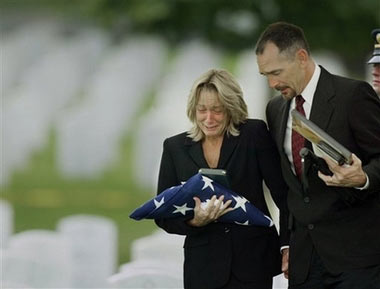 Kim Hitzges, left, mother of Army Spc. Chad Keith is comforted by her husband Mark Hitzges as they attend funeral services for Keith in this Aug. 1, 2003 file photo, at Arlington National Cemetery. Keith of Batesville, Ind., was killed on July 7 when a roadside bomb exploded as he was patrolling Baghdad, Iraq. [AP]  |
Washington - Americans are keenly aware of how many US forces have lost their lives in Iraq, according to a new AP-Ipsos poll. But they woefully underestimate the number of Iraqi civilians who have been killed.
When the poll was conducted earlier this month, a little more than 3,100 US troops had been killed. The midpoint estimate among those polled was right on target, at about 3,000.
Far from a vague statistic, the death toll is painfully real for many Americans. Seventeen percent in the poll know someone who has been killed or wounded in Iraq. And among adults under 35, those closest to the ages of those deployed, 27 percent know someone who has been killed or wounded.
For Daniel Herman, a lawyer in New Castle, Pa., a co-worker's nephew is the human face of the dead.
"This is a fairly rural area," he said. "When somebody dies, ... you hear about it. It makes it very concrete to you."
The number of Iraqis killed, however, is much harder to pin down, and that uncertainty is perhaps reflected in Americans' tendency to lowball the Iraqi death toll by tens of thousands.
Iraqi civilian deaths are estimated at more than 54,000 and could be much higher; some unofficial estimates range into the hundreds of thousands. The UN Assistance Mission for Iraq reports more than 34,000 deaths in 2006 alone.
Among those polled for the AP survey, however, the median estimate of Iraqi deaths was 9,890. The median is the point at which half the estimates were higher and half lower.
Christopher Gelpi, a Duke University political scientist who tracks public opinion on war casualties, said a better understanding of the Iraqi death toll probably wouldn't change already negative public attitudes toward the war much. People in democracies generally don't shy away from inflicting civilian casualties, he said, and they may be even more tolerant of them in situations such as Iraq, where many of the civilian deaths are caused by other Iraqis.
"You have to look at who's doing the killing," said Neal Crawford, a restaurant manager in Suttons Bay, Mich., who guessed that about 10,000 Iraqis had been killed. "If these people are dying because a roadside bomb goes off or if there's an insurgent attack in a marketplace, it's an unfortunate circumstance of war, people die."
Gelpi said that while Americans may not view Iraqi deaths through the same prism as American losses, they may use the Iraqi death toll to gauge progress, or lack thereof, on the US effort to promote a stable, secure democracy in Iraq.
To many, he said, "the fact that so many are being killed is an indication that we're not succeeding."
Whatever their understanding of the respective death tolls, three-quarters of those polled said the numbers of both Americans and Iraqis who have been killed are "unacceptable." Two-thirds said they tend to feel upset when a soldier dies, while the rest say such deaths are unfortunate but part of what war is about.
Sometimes it's hard for people to sort out their conflicting emotions.
"I don't know if I'm numb to it or not," said 86-year-old Robert Lipold of Las Vegas. "It's something you see in the paper every day there. And how do you feel when in the back of your mind it's unnecessary?"
Given a range of possible words to describe their feelings about the overall situation in Iraq, people were most likely to identify with "worried," selected by 81 percent of those surveyed.
Other descriptive words selected by respondents:
-- Compassionate: 74 percent.
-- Angry: 62 percent.
-- Tired: 61 percent.
-- Hopeful: 51 percent.
-- Proud: 38 percent.
-- Numb: 27 percent.
Women were more likely than men to feel worried, compassionate, angry and tired; men were more likely than women to feel proud, a finding consistent with traditional differences in attitudes toward war between the sexes.
For women, said Gelpi, "there is an emotional response to casualties that men don't show. ... It could be some sort of socialization that men get about the military or combat as being honorable that women don't get."
Charlotte Pirch, a lawyer from Fountain Valley, Calif., said she's "always appalled and just very upset at hearing about more casualties, whether it's US troops or troops from another country."
Pirch said two of her nieces are married to men who served in Iraq and she doesn't live far from Camp Pendleton, which has sent many US troops to Iraq. But she added, "Whether I knew someone personally or not, I would still feel it as a citizen of our country."
Perhaps surprisingly, the poll found little difference in attitudes toward the war between those who did and did not know someone who had been killed or wounded. There was a difference, however, in their opinions on whether opponents are right to criticize the war.
About half of those who know someone who has been killed or wounded felt it is right to criticize the war, compared with two-thirds of those who don't have a personal connection.
The AP-Ipsos poll of 1,002 adults, conducted Feb. 12-15, had a 3 percentage point margin of error.
|
||
|
||
|
|