Global warming-hurricane link debated
(Reuters)Updated: 2007-05-28 11:30
Washington - Climate scientists agree there have been a lot of strong hurricanes lately. They agree that warmer seas have given these storms some extra punch. But they disagree how much global warming is to blame.
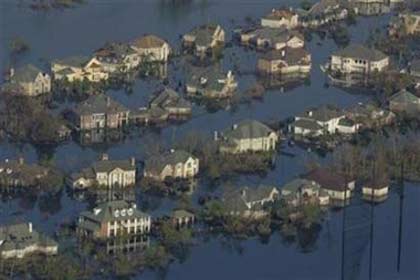 Neighborhoods are flooded with oil and water two weeks after Hurricane Katrina went though New Orleans, September 12, 2005. [Reuters/file]  |
With the 2007 Atlantic hurricane season about to begin, the controversy over the role of climate change in boosting hurricane intensity is a matter for debate among the researchers who watch the water and the clouds and work to figure out what makes the worst storms so furious.
"As far as I can tell, there is no dispute that higher sea temperatures mean more energy for these storms to feed on," said Kevin Trenberth of the National Center for Atmospheric Research in Boulder, Colorado, part of a consortium of US universities.
Trenberth said the next logical question is, how have sea surface temperatures changed over the last 30 years or so, "and that's where the global warming aspects come in and that's where some of the dispute seems to lie."
Trenberth is convinced that global warming is a major factor in spawning the kinds of intense hurricanes that kill, and he is hardly alone.
The U.N. Intergovernmental Panel on Climate Change, which set out the consequences of global warming in a series of reports this year, said future hurricanes and typhoons will probably be more intense as tropical seas continue to heat up.
The world panel also drew a line between warmer seas and the release of greenhouse gases like carbon dioxide from human sources like factories, vehicles and coal-fired power plants.
However, Chris Landsea of the US government's National Hurricane Center in Miami considers climate change a minor piece of the puzzle of hurricane intensity compared with long-term climate cycles that can last for decades.
How Much Impact From Global Warming?
When it comes to the relationship between hurricane strength and global warming, "the important question is not, is there an impact, but how much of an impact," Landsea said in a telephone interview. "When you look at all of the studies ... it's a pretty tiny sensitivity."
Landsea said hurricanes get about 2 percent stronger for every rise of 1 degree F (.55C) in the sea surface temperature.
Sea surface temperatures have risen an average of about that much in the tropical Atlantic, the Caribbean and the Gulf of Mexico -- where big hurricanes are nourished -- over the last 100 years, and only about half of that increase is due to human-caused global warming, he said.
He said that 1 percent difference in intensity, gauged by the force of the storm winds, makes little difference, even in a storm with the devastating strength of 2005's Katrina, a top-ranked Category 5 hurricane.
"Consider that we can only estimate winds to the nearest 5 miles an hour here at the hurricane center and when you get to Category 4 or 5, you're really making a guess to the nearest 10 miles an hour," Landsea said. "A 1- or 2-mile an hour change is so tiny you can't even measure it."
But Trenberth noted that global climate change was a big factor in driving the spike in sea surface warming in 2005, a hurricane season that broke records for its intensity.
Tropical sea temperatures were up by 1.6 degrees F (.92 degree C) in 2005. "That's way higher than the next highest on record for the period," Trenberth said. Global warming accounted for about half of that rise, he said.
By contrast, the Pacific Ocean phenomenon El Nino accounted for .38 degrees F (.2 degrees C) of tropic sea warming that year, and a long-term cycle of warming and cooling known as the Atlantic Multi-Decadal Oscillation accounted for .19 degrees F (.1 degree C), according to Trenberth.
'Global Warming Doesn't Go Away'
"The key thing about global warming is it doesn't go away," Trenberth said. "It provides a background level (of warming), and the natural fluctuations can be thought of as occurring on top of it."
Kerry Emanuel, a climate scientist at the Massachusetts Institute of Technology, stated plainly that human-caused global warming contributes to hurricane intensity.
"There has been a large upswing in the frequency of Atlantic hurricanes, beginning in 1995," Emanuel said on his Web site, http://wind.mit.edu/~emanuel/anthro2.htm. "This corresponds to an upswing in tropical North Atlantic sea surface temperature, which is very likely a response to increasing anthropogenic (human-caused) greenhouse gases."
Emanuel said there was no evidence that natural cycles or regional Atlantic climate phenomena are affecting sea surface temperatures, which have an impact on hurricanes.
John Holdren, a climate scientist at Harvard University and chairman of the board of the American Association for the Advancement of Science, said he found Emanuel's work extremely persuasive -- a "smoking gun" supporting the impact of climate change on hurricanes.
The matter is not settled. A study published in Nature last week said hurricanes over the past 5,000 years appear to have been controlled more by El Nino and an African monsoon than warm local sea surface temperatures.
|
||
|
||
|
|