Americas
Iraq ambush caps bloodiest months for US
(AP)
Updated: 2007-06-30 05:01
 |
Large Medium Small |
|
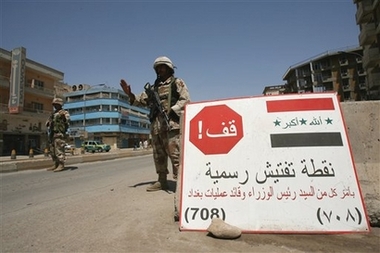

Seven soldiers were wounded in the attack Thursday in the Rasheed district, a mixed Sunni-Shiite area of southern Baghdad where U.S.-led forces recently stepped up pressure on extremists. The commander of U.S. forces in Baghdad suggested the ambush could be part of an escalating backlash by Sunni insurgents.
Those deaths brought to 99 the number of U.S. troops killed this month, according to an Associated Press count. The toll for the past three months — 329 — made it the deadliest quarter for U.S. troops in Iraq since the March 2003 invasion. That surpasses the 316 soldiers killed during November 2004 to January 2005.
Maj. Gen. Joseph F. Fil Jr., who heads U.S. forces in the Iraqi capital, said U.S. casualties had mounted because Sunni extremists are "starting to fight very hard" as U.S. forces press into areas of the capital where militants once had free rein.
"This is a skilled and determined enemy. He's ruthless. He's got a thirst for blood like I've never seen anywhere in my life," Fil told reporters. "And he's determined to do whatever he can."
During a teleconference with Pentagon reporters, Fil described the Thursday attack as "very violent," displaying a "level of sophistication that we have not often seen so far in this campaign."
He said a blast from a "very large" bomb buried deep in the ground triggered the attack, which was followed by volleys of small-arms fire and rocket-propelled grenades. Four soldiers were killed in the attack and a fifth died Thursday night of his wounds, Fil said.
"As far as the assessment, we believe that we are into an area" of south Baghdad "where we're seeing a very strong al-Qaida cell," Fil said. "Those areas are now denied to them ... They are starting to fight very hard and that's what we saw yesterday."
Sunni insurgents have used similar "swarming" tactics for years, mostly in rural areas to the north and west of the capital. Militants have also been burying explosives deep in the ground, making them difficult to detect and triggering them as vehicles pass by.
Such "deep buried bombs" have been especially effective against U.S. vehicles, including Humvees, Bradley fighting vehicles and Strykers, prompting commanders in some areas to shift to foot patrols to avoid losing so many soldiers in a single blast.
U.S. casualties have been rising since President Bush ordered nearly 30,000 more troops to Iraq in a major push to pacify Baghdad and surrounding areas. The goal was to curb the violence so Iraq's Shiite, Sunni and Kurdish leaders can strike agreements to share power in this fractious country.
But progress toward agreements to share oil wealth, provide a greater political role to the Sunni minority and shore up local governments has been slow because of deep suspicions after four years of bloodshed.
In a hopeful sign, radical Shiite cleric Muqtada al-Sadr called off a July 5 march to a bombed shrine in Samarra north of Baghdad after appeals from the government, which feared Sunni extremists would attack marchers along the way.
Sheik Asad Al-Nassiri, an aide to the cleric, told a congregation at Friday prayer services in Kufa that al-Sadr canceled the march because of "the government's inability to secure the route and many officials' appeals for a postponement."
At the same time, however, anger has been welling up among Sunni Arabs, who complain they are being marginalized in the Shiite-dominated government.
A Sunni political party said Friday that four Sunni Cabinet members will refuse to attend government meetings to protest the way Prime Minister Nouri al-Maliki handled legal proceedings against the fifth Sunni minister.
Earlier this week, an arrest warrant was issued for Culture Minister Asad Kamal al-Hashimi and security forces raided his Baghdad home after allegations he masterminded an assassination attempt against a politician two years ago.
Sunni politicians considered the move politically motivated and asked al-Maliki, a Shiite, to do something to stop it. The prime minister refused, saying he would not intervene in the work of the judiciary.
"The ministers have decided to suspend their participation in government meetings because they consider the stance of the prime minister and the government unsuitable," Ayad al-Samarraie, a leading member of the Sunni bloc the Iraqi Accordance Front, told AP.
"Had this minister been a member of his (al-Maliki's) party, would he have dealt with the matter the way he did?" al-Samarraie asked.
Muhannad al-Issawi, a spokesman for Accordance Front leader Adnan al-Dulaimi, said the boycott of the 37-member Cabinet "will continue until a compromise is reached."
Al-Issawi said the Sunnis were also protesting the dismissal this month of the Sunni speaker of parliament, who was voted out by the legislators because of erratic behavior.
In April, six Cabinet ministers loyal to al-Sadr quit the government to protest his refusal to call for a timetable for American troops to leave. They have not been replaced.
The boycotts are likely to complicate efforts to enact key "benchmark" legislation that the U.S. is demanding, since the Cabinet must sign off on such proposals before they go to parliament.
Even if the other Shiite and Kurdish members give their endorsement, the absence of key constituencies from the decision-making process would raise doubts whether such legislation would contribute to the goal of national reconciliation.
Elsewhere Friday, a suicide truck bomber attacked an Iraqi army post 20 miles north of the capital Friday, killing six soldiers and wounding five others, police said. Two civilians were also killed in a barrage of gunfire that followed, they said.
The blast occurred at a railway station in Mishada, an officer said on condition of anonymity because he was not authorized to release the information.
Iraqi police said a bomb exploded under a pipeline south of Baghdad, spilling crude oil and sparking a huge fire. The pipeline carries oil from Iraq's southern oil fields to the Dora refinery in the capital.
| 分享按鈕 |