Talking to al Qaeda? Don't rule it out, some say
Updated: 2007-09-14 10:13
London -- Six years after the September 11 attacks, a few cautious voices are beginning to suggest the unthinkable -- maybe it is time to consider talking to al Qaeda.
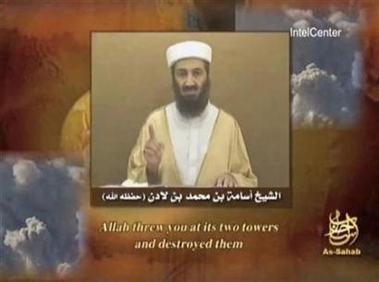 Al Qaeda leader Osama bin Laden is seen speaking in this video grab provided to Reuters on September 11, 2007. [Reuters] |
The idea will revolt some people and raises obvious questions -- through what channels could such a dialogue take place and what would there be to negotiate?
But proponents say al Qaeda has established itself as a de facto power, whether the West likes it or not, and history shows militant movements are best neutralized by negotiation, not war.
"No insurgency or terrorism has been defeated by warfare or violence," former Anglican church envoy and hostage negotiator Terry Waite said in a debate on BBC World television.
"There are some rational players in al Qaeda but it also attracts the psychotic. We need to seek an entry point," said the Briton, himself a captive in Lebanon from 1987 to 1991.
Jan Egeland, a Norwegian who helped broker secret talks between Israel and the Palestine Liberation Organisation in the 1990s and later, as a top UN official, dealt with warlords and guerrilla leaders from Colombia to Uganda, said: "I wouldn't rule out speaking to anybody, a priori."
He went on: "It depends on who you speak to, but also what you speak to them about. I'm willing to speak to the devil to help the victims in the depths of hell. If I could have a meeting with al Qaeda where one could impress upon them that they are the biggest anti-Islamic force around, why not?"
Endless Struggle
But Egeland and others point out there are huge obstacles to negotiating with al Qaeda, even if Western governments could overcome their revulsion towards it.
Unlike, say, Colombia's FARC rebels, the Irish Republican Army in Northern Ireland or the Afghan Taliban, to whom President Hamid Karzai renewed an offer of talks this week, al Qaeda is not so much an organization as an idea.
Its vision -- to create a global Muslim caliphate and convert even the United States to Islam, as its leader Osama bin Laden urged in a video last week -- is a dream that is not confined within national boundaries and leaves no room for compromise, or even realistic discussion.
"Al Qaeda is a universal movement and its demand is universal. It cannot be met by one single government. They're talking about the whole Islamic world," said Mustafa Alani, security analyst at the Gulf Research Center in Dubai.
Some experts use the terms 'tactical terrorism' and 'strategic terrorism' to differentiate between traditional militant groups, typically fighting for negotiable demands such as political representation or independence, and those like al Qaeda for which perpetual struggle appears an end in itself.
"It's an endless struggle. The principle of jihad will not accept half-solutions. Either you are in the black or in the white. There is no middle ground. You are either a kafir (infidel) or you are a jihadi," said Alani.
Calculus of Pain
Historically, analysts say, the issue of whether to talk to groups labeled terrorists is usually decisively influenced by the realization that there is no way to defeat them.
"When we can't win a war, we sit down and talk with terrorists and we stop calling them terrorists," said Mark Perry, Washington-based director of Conflicts Forum, which tries to build bridges between the West and political Islam.
So if the war on terrorism fails to beat al Qaeda, might we one day sit down with them?
"I suppose it's thinkable. You'd have to make a pain-pleasure calculus ... how many casualties are we going to be able to sustain?" said Perry, whose organization promotes dialogue with groups like Hamas.
For Egeland, who now heads the Norwegian Institute of International Affairs, one peril of entering negotiations is to confer legitimacy on your opponent, sending a signal that anyone who commits mass murder will be treated as a serious actor.
But he believes there may come a time when cracks appear in al Qaeda and negotiations can help split it further.
"One likely scenario with al Qaeda is that they will indeed become increasingly unpopular in the Muslim world and they will split and there will be back channels (of negotiation) to various of their networks," he said.
"That will be done by religious groups, by Muslim groups working with smaller actors, smaller countries. Middle Eastern countries, perhaps radical countries will be involved, that's the new way of diplomacy. It's not going to be the European Union or the US doing it."
|
|
|
||
|
||
|
|
|
|