Japanese whalers chafe under curbs
Updated: 2007-11-18 14:24
WADA, Japan - A whale's bleeding carcass bobbed in the surf, a steel harpoon jutting from its side. Then butchers at this Japanese fishing village went to work, turning a motorized winch to haul the beast ashore.
On the flensing floor, the men blessed it with rice wine -- then hacked through blubber and sinew with long-handled knives, slicing vermilion flesh from the massive spine. Blood gushed from the 30-foot Baird's beaked whale like water from a hydrant.
|
|
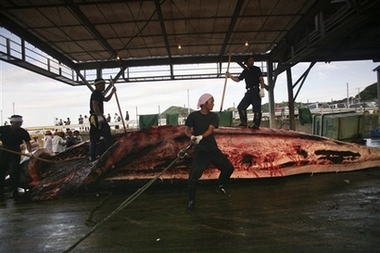
Finally, the meat was chopped into brick-sized blocks, weighed and priced for townsfolk who lined up for their purchases. Restaurateurs drove away with plastic drums of whale.
For the world's anti-whaling activists, it's an atrocity that must be stopped. But the men who harpoon, flense and sell these whales at four small-scale coastal hunting communities have another word for it: tradition.
"Coastal people have been eating whale for 400 years and we have a right to decide what we eat," declared Yoshinori Shoji, head of the Gaibo Hogei whaling company, based in Wada, a two-hour drive east of Tokyo.
These days, that "tradition" is much harder to maintain.
Even though the 1986 international moratorium on commercial whaling applies more to the high seas than to Japanese coastal outfits, it has severely cut supply, driving prices higher and speeding the meat's plunge in popularity.
The ban also restricts the types of smaller whales that can be hunted, such as a former favorite of the coastal operations -- the minke. Small-time whalers now commercially hunt only whales that are not regulated internationally.
Japan's coastal whalers also suffer from a global PR problem.
Amid an active anti-whaling movement, many people in Europe, the United States, Australia and New Zealand consider killing whales an environmental and moral crime, and grisly scenes such as the ones in Wada reinforce the image of whaling as barbaric.
The campaign touches a nationalist chord among Japanese, who feel it's discriminatory and hypocritical, given that Japanese whaling only took off after World War II because U.S. occupation authorities encouraged it as a source of food.
"They just completely reject people whose thinking isn't the same as theirs," says the industry's point man in the southern whaling town of Taiji, Yoji Kita. "In their `global standard,' there are a lot of double standards."
When people here speak of tradition, they mean family-owned company boats targeting small game just 20 miles from the shore, rather than the Japanese factory fleets, which range as far afield as the Antarctic and pull in a total of more than 1,000 whales per year.
This year, coastal whalers operating out of four main ports are set to take a total of 66 Baird's beaked whales, 72 pilot whales -- which look like dolphins -- and 20 Risso dolphins.
Minke whales, of which they used to take 300 a year, have been banned from the hunt by the International Whaling Commission since the 1980s, though Japan takes many minke whales -- and eats the meat -- as part of an IWC-allowed scientific whaling program.
The whaling companies, however, say the moratorium is sinking their business.
Japan's eight coastal whaling companies now use only five of their nine whaling boats for coastal operations. Populations in whaling towns have dropped, and village administrators complain about shrinking tax bases.
"Everyone here is in the red," Shoji said as his men sliced fat from the cubes of meat and dumped buckets of innards into a huge vat for processing into fertilizer.
The complaint gets little international sympathy.
A Japanese proposal to win "community whaling" status that would have allowed limited minke whale hunts failed at an IWC meeting in May. Critics argue that Japan's coastal operations are strictly commercial, using modern industrial methods such as mechanized harpoon guns, while community hunts are conducted by aboriginal people as ceremonies or to harvest a vital food source.
"Long ago, they used their own boats and caught whales with nets. But since the early 1900s, they've been using methods imported from Norway," said Junichi Sato of Greenpeace Japan. "So it's not at all as if they were preserving a tradition."
Coastal whalers argue that while they hunt whales as food and fertilizer, the Western whalers of old were only after them for their oil and discarded the rest.
Also playing into the argument are race, the legacy of the war and a sense of Japan being perennial odd man out in global affairs dominated by the United States and Europe.
"It looks like we're part of the club, but then something happens, and they point at us and say, `You're the country that started the war!'" said Kita. "I feel the whaling issue is a racial discrimination issue."
This touchiness is heightened by the Taiji area's autumn and winter dolphin hunt, when boat crews surround schools of the animals and slash them to death. The kills are often filmed by animal rights groups and broadcast worldwide.
Towns like Wada and Taiji have responded with campaigns to teach pride in the whaling tradition in local schools, where whale meat often features on the lunch menu, despite evidence that whale and dolphin meat is contaminated with mercury.
Wada, for instance, hosts school groups to witness whale flensings, though the copious blood and stench occasionally sickens a student. The kids then gather at a nearby cafeteria for a whale meat breakfast.
|
|
|
||
|
||
|
|
|
|