
Al-Sadr may restart full-scale fight against US in Iraq
Updated: 2008-04-25 07:11
BAGHDAD - Muqtada al-Sadr is considering setting aside his political ambitions and restarting a full-scale fight against US-led forces -- a worrisome shift that may reflect Iranian influence on the young cleric and could open the way for a shadow state protected by his powerful Mahdi Army.
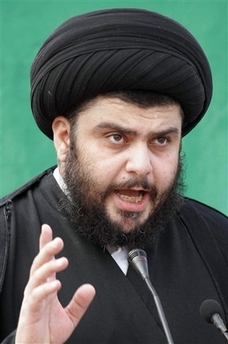 In this Oct. 24, 2006 file photo, Muqtada al-Sadr, radical Shiite cleric and a chief of the Mahdi Army militia, addresses his followers after Eid al-Fitr prayer in Najaf. Iraq. Muqtada al-Sadr is shifting his focus away from politics and toward fighting US and Iraqi government forces as a top priority, a change of course that maybe the result of Iranian influence on the cleric, according to Shiite lawmakers and politicians. [Agencies] |
A possible breakaway path -- described to The Associated Press by Shiite lawmakers and politicians -- would represent the ultimate backlash to the Iraqi government's pressure on al-Sadr to renounce and disband his Shiite militia.
By snubbing the give-and-take of politics, al-Sadr would have a freer hand to carve out a kind of parallel state with its own militia and social services along the lines of Hezbollah in Lebanon, a Shiite group founded with Iran's help in the 1980s.
It also would carry potentially disastrous security implications as the Pentagon trims its troops strength and Prime Minister Nouri al-Maliki finally shows progress on national reconciliation.
Last week, the main Sunni political bloc announced provisional plans to rejoin the Shiite-led coalition nine months after quitting the government. The Sunnis are pleased with the squeeze on al-Sadr's movement as well as an amnesty law that could free many detainees.
"Muqtada has shown a great deal of patience not calling for an all-out war yet with so much pressure on him," said Mohan Abedin, director of research at London's Center for the Study of Terrorism and an expert on Shiite affairs. "The Mahdi Army is by far the most powerful Iraqi faction. It can cause damage on a massive scale if it goes to war."
Al-Sadr's next move is still uncertain, but he clearly holds important cards.
The Mahdi Army is estimated to have about 60,000 fighters -- with at least 5,000 thought to be highly trained commandos -- and is emboldened by its strong resistance to an Iraqi-led crackdown launched last month in the southern city of Basra and elsewhere.
Al-Sadr's movement also holds sway over the densely populated Shiite parts of Baghdad and across the Shiite south by controlling vital needs such as fuel and running social services such as clinics.
A cease-fire declared last summer by al-Sadr has been credited with helping bring a steep drop violence.
But al-Sadr -- who has been in the Iranian seminary city of Qom for the past year -- is seriously considering tearing up the truce and disassociating himself from his political bloc in parliament, according to loyalists and Shiite politicians interviewed by the AP over the past two weeks.
Then al-Sadr would be free to unleash Mahdi attacks on US and Iraqi forces, the political insiders said.
They include members of the 30-seat Sadrist faction in parliament and members of rival Shiite parties, including two who saw al-Sadr recently in Iran. All requested anonymity because of the sensitivity of the subject.
"The emphasis is now on weapons and fighting, not politics," said one of the lawmakers in the Sadrist bloc. "(Al-Sadr) now only communicates with the Mahdi Army commanders."
Any Mahdi Army offensive could have serious repercussions. Mahdi fighters engaged in fierce battles with US forces in 2004 and then were blamed for waves of roadside bombings that were once the chief killer of American troops.
Mahdi militiamen also fought Iraqi security forces to a virtual standstill last month in Basra before an Iranian-supervised truce.
It's unknown how much al-Sadr's Iranian hosts are shaping his views.
Al-Sadr, who is in his mid-30s, is studying in Qom under the supervision of Ayatollah Kazim al-Haeri, a reclusive Iraqi cleric close to Iranian hard-liners.
Washington accuses Iran of aiding Shiite militias in Iraq, including so-called "special groups" with murky ties to the Mahdi mainstream. Iran denies the allegations.
But Iran has obvious and well known connections to the main Shiite political groups in al-Maliki's government. During the recent battles in Basra, Iran supported al-Maliki's crackdown on so-called "criminals" but did not make a clear statement on the spillover confrontation with the Mahdi Army.


|
||
|
||
|
|
|
|