
New idea in mortuary science: Dissolving bodies with lye
Updated: 2008-05-09 10:53
CONCORD, N.H. -- Since they first walked the planet, humans have either buried or burned their dead. Now a new option is generating interest -- dissolving bodies in lye and flushing the brownish, syrupy residue down the drain.
The process is called alkaline hydrolysis and was developed in this country 16 years ago to get rid of animal carcasses. It uses lye, 300-degree heat and 60 pounds of pressure per square inch to destroy bodies in big stainless-steel cylinders that are similar to pressure cookers.
|
|
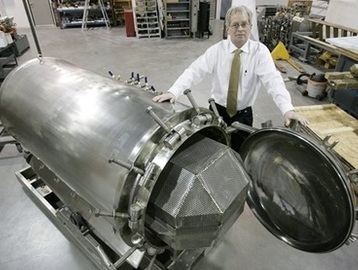
No funeral homes in the US -- or anywhere else in the world, as far as the equipment manufacturer knows -- offer it. In fact, only two US medical centers use it on human bodies, and only on cadavers donated for research.
But because of its environmental advantages, some in the funeral industry say it could someday rival burial and cremation.
"It's not often that a truly game-changing technology comes along in the funeral service," the newsletter Funeral Service Insider said in September. But "we might have gotten a hold of one."
Getting the public to accept a process that strikes some as ghastly may be the biggest challenge. Psychopaths and dictators have used acid or lye to torture or erase their victims, and legislation to make alkaline hydrolysis available to the public in New York state was branded "Hannibal Lecter's bill" in a play on the sponsor's name -- Sen. Kemp Hannon -- and the movie character's sadism.
Alkaline hydrolysis is legal in Minnesota and in New Hampshire, where a Manchester funeral director is pushing to offer it. But he has yet to line up the necessary regulatory approvals, and some New Hampshire lawmakers want to repeal the little-noticed 2006 state law legalizing it.
"We believe this process, which enables a portion of human remains to be flushed down a drain, to be undignified," said Patrick McGee, a spokesman for the Roman Catholic Diocese of Manchester.
State Rep. Barbara French said she, for one, might choose alkaline hydrolysis.
"I'm getting near that age and thought about cremation, but this is equally as good and less of an environmental problem," the 81-year-old lawmaker said. "It doesn't bother me any more than being burned up. Cremation, you're burned up. I've thought about it, but I'm dead."
In addition to the liquid, the process leaves a dry bone residue similar in appearance and volume to cremated remains. It could be returned to the family in an urn or buried in a cemetery.
The coffee-colored liquid has the consistency of motor oil and a strong ammonia smell. But proponents say it is sterile and can, in most cases, be safely poured down the drain, provided the operation has the necessary permits.
Alkaline hydrolysis doesn't take up as much space in cemeteries as burial. And the process could ease concerns about crematorium emissions, including carbon dioxide as well as mercury from silver dental fillings.
The University of Florida in Gainesville and the Mayo Clinic in Rochester, Minn., have used alkaline hydrolysis to dispose of cadavers since the mid-1990s and 2005, respectively.
Brad Crain, president of BioSafe Engineering, the Brownsburg, Ind., company that makes the steel cylinders, estimated 40 to 50 other facilities use them on human medical waste, animal carcasses or both. The users include veterinary schools, universities, pharmaceutical companies and the US government.
Liquid waste from cadavers goes down the drain at the both the Mayo Clinic and the University of Florida, as does the liquid residue from human tissue and animal carcasses at alkaline hydrolysis sites elsewhere.
Manchester funeral director Chad Corbin wants to operate a $300,000 cylinder in New Hampshire. He said that an alkaline hydrolysis operation is more expensive to set up than a crematorium but that he would charge customers about as much as he would for cremation.
George Carlson, an industrial-waste manager for the New Hampshire Department of Environmental Services, said things the public might find more troubling routinely flow into sewage treatment plants in the US all the time. That includes blood and spillover embalming fluid from funeral homes.
The department issued a permit to Corbin last year, but he let the deal on the property fall through because of delays in getting the other necessary permits. Now he must go through the process all over again, and there is gathering resistance. But he said he is undeterred.
"I don't not know how long it will take," he said recently, "but eventually it will happen."
|
||
|
||
|
|
|
|