WORLD> America

|
WORLD> America
|
|
NASA spacecraft successfully lands on Mars
(Agencies)
Updated: 2008-05-26 08:55 PASADENA, California - A NASA spacecraft plunged into the atmosphere of Mars and landed in the Red Planet's northern polar region on Sunday to begin 90 days of digging in the permafrost to look for evidence of the building blocks of life.
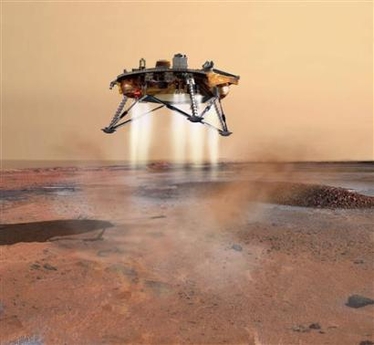
Cheers swept through mission control at NASA's Jet Propulsion Laboratory when the touchdown signal from the Phoenix Mars Landers was detected after a nailbiting descent. "In my dreams it couldn't have gone as perfectly as it went," project manager Barry Goldstein said. "It went right down the middle." Among Phoenix's first tasks were to check its power supply and the health of its science instruments, and unfurl its solar panels after the dust settled. Mission managers said there would be a two-hour blackout period as Phoenix conducted the checks while out of view from Earth. Phoenix plunged into the Martian atmosphere at more than 12,000 mph after a 10-month, 422 million-mile voyage through space. It performed a choreographed dance that included unfurling its parachute, shedding its heat shield and backshell, and firing thrusters to slow to a 5 mph touchdown. It's the first successful soft landing on Mars since the twin Viking landers touched down in 1976. NASA's twin rovers, which successfully landed on Mars four years ago, used a combination of parachutes and cushioned air bags to bounce to the surface. Phoenix's landing is a relief for NASA since Mars has a reputation of swallowing spacecraft. More than half of all nations' attempts to land on Mars have failed. Phoenix's target landing site was 30-mile-wide shallow valley in the high northern latitudes similar in location to Earth's Greenland or northern Alaska. The site was chosen because images from space spied evidence of a reservoir of frozen water close to the surface. Like a tourist in a foreign country, the lander initially will take in the sights during its first week on the Red Planet. It will talk with ground controllers through three Mars orbiters, which will relay data and images. Phoenix is equipped with an 8-foot-long arm capable of digging trenches in the soil to get to ice that is believed to be buried inches to a foot deep. Then it will analyze the dirt and ice samples for traces of organic compounds, the chemical building blocks of life. The lander also will study whether the ice ever melted at some point in Mars' history when the planet had a warmer environment than the current harsh, cold one it currently has. Scientists do not expect to find water in its liquid form at the Phoenix landing site because it's too frigid. But they say that if raw ingredients of life exist anywhere on the planet, they likely would be preserved in the ice. Phoenix, however, cannot detect signs of alien life that may exist now or once existed. The only other time NASA searched for chemical signs of life was during the Viking missions. Neither lander found conclusive evidence of life. Phoenix avoided the doom of its sister spacecraft, the Mars Polar Lander, which in 1999 crashed into the south pole after prematurely cutting off its engines. The Polar Lander loss, along with the earlier loss of an orbiter the same year, forced NASA to overhaul its Mars exploration program. Phoenix, named after the mythical bird that is reborn from its ashes, inherited hardware from a lander mission that was scrapped after the back-to-back Mars losses, and carries similar instruments that flew on Polar Lander. Built by Lockheed Martin Corp., Phoenix is the first mission from NASA's Scout program, a lower-cost complement to the space agency's pricier Mars missions. It cost $420 million to develop and launch Phoenix compared to the $820 million originally invested in the twin rovers. The rovers have dazzled scientists with their Energizer Bunny-like ability to keep going and their geologic findings that ancient Mars once had water that flowed at or near the surface. Mission managers do not expect Phoenix to be as hardy as the rovers since winter will set in later this year at the landing site with fewer hours of sunlight available each day to power the lander's solar panels. |