WORLD> Africa

|
WORLD> Africa
|
|
Egypt uncovers 'missing' pyramid of a pharaoh
(Agencies)
Updated: 2008-06-06 10:03 SAQQARA, Egypt -- Egyptian archaeologists unveiled on Thursday a 4,000-year-old "missing pyramid" that is believed to have been discovered by an archaeologist almost 200 years ago and never seen again. Zahi Hawass, Egypt's antiquities chief, said the pyramid appears to have been built by King Menkauhor, an obscure pharaoh who ruled for only eight years. In 1842, German archaeologist Karl Richard Lepsius mentioned it among his finds at Saqqara, referring to it as number 29 and calling it the "Headless Pyramid" because only its base remains. But the desert sands covered the discovery, and no archaeologist since has been able to find Menkauhor's resting place.
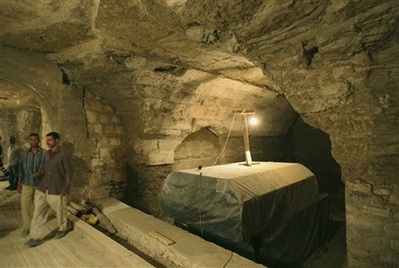
"We have filled the gap of the missing pyramid," Hawass told reporters on a tour of the discoveries at Saqqara, the necropolis and burial site of the rulers of ancient Memphis, the capital of Egypt's Old Kingdom, about 12 miles south of Cairo. The team also announced the discovery of part of a ceremonial procession road where high priests, their faces obscured by masks, once carried mummified sacred bulls worshipped in the ancient Egyptian capital of Memphis. The pyramid's base — or the superstructure as archeologists call it — was found after a 25-foot-high mound of sand was removed over the past year and a half by Hawass' team. Hawass said the style of the pyramid indicates it was from the Fifth Dynasty, a period that began in 2,465 B.C. and ended in 2,325 B.C. That would put it about two centuries after the completion of the Great Pyramid of Giza, believed to have been finished in 2,500 B.C. Another proof of its date, Hawass says, was the discovery inside the pyramid of a gray granite lid of a sarcophagus, of the type used at that time. The rectangular base, at the bottom of a 15 foot-deep pit dug out by workers, gives little indication of how imposing the pyramid might have once been. Heaps of huge rocks, many still partially covered in sand and dust, mark the pyramid's walls and entrance, and a burial chamber was discovered inside. Archaeologists have not found a cartouche — a pharaoh's name in hieroglyphs — of the pyramid's owner. But Hawass said that based on the estimated date of the pyramid he was convinced it belonged to Menkauhor. Work continues at the site, where Hawass said he expected to unearth "subsidiary" pyramids around Menkauhor's main one, and hoped to find inscriptions there to back up his claim. The partial ceremonial procession road unveiled Thursday dates back to the Ptolemaic period, which ran for about 300 years before 30 B.C. It runs alongside Menkauhor's pyramid, leading from a mummification chamber toward the Saqqara Serapium, a network of underground tombs where sacred bulls were interred, discovered by French archaeologist August Mariette in 1850. A high priest would carry the mummified bulls' remains down the procession road — the only human allegedly allowed to walk on it — to the chambers where the bulls would be placed in sarcophagi, Hawass said. Ancient Egyptians considered Apis Bulls to be incarnations of the city god of Memphis and connected with fertility and the sun-cult. A bull would be chosen for its deep black coloring and would be required to have a single white mark between the horns. Selected by priests and honored until death, it was then later mummified and buried in the underground galleries of the Serapium. The procession route's discovery "adds an important part to our knowledge of the Old Kingdom and its rituals," Hawass said. The sprawling archaeological site at Saqqara is most famous for the Step Pyramid of King Djoser — the oldest of Egypt's over 100 pyramids, built in the 27th century B.C. Although archaeologists have been exploring Egypt for some 200 years, Hawass says only a third of what lies underground in Saqqara has been discovered. "You never know what secrets the sands of Egypt hide," he said. "I always believe there will be more pyramids to discover." |