WORLD> Global General

|
WORLD> Global General
|
|
How Mars and Alaska are alike
(Agencies)
Updated: 2008-07-18 14:05 Little did Bucknell University geology professors Craig Kochel and Jeffrey Trop know, as they were working in Alaska, that they would soon predict one of the most important planetary observations ever made. The pair was in Alaska for an eight-day trip in July 2006, studying geological features and the processes that create them. As they studied photographs taken of the surrounding area, some features caught Kochel's eye. He thought they were strangely familiar, and then realized they reminded him of images he'd seen when working on the Viking missions to Mars in the 1970s.
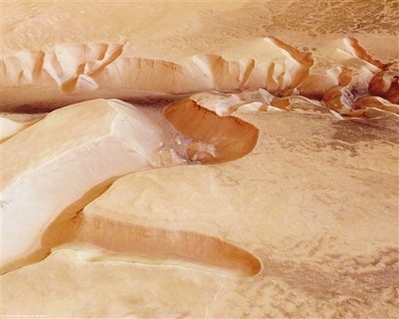
Kochel and Trop trekked to where the shots were taken overlooking a glacier. Spotting triangle-shaped landforms called "fans" sealed the deal: They looked strikingly similar to photographs taken of features on Mars. Mystery solved Although geologists can usually tell what shapes the landscape around us, it was a mystery what formed the Mars-like features found in Alaska. The conditions on Mars are quite different than anything experienced on Earth. For example, Mars is much colder than even the Arctic -- the average martian temperature is -81 degrees F (-63 degrees C) -- and the planet's atmospheric pressure is lower than Earth's. Still, for the same features to be present on Earth and Mars, the two professors suspected similar processes would have made them. They had just over a week in Alaska to discover what created the glaciers and fans. During this time they managed to see an impressive 289 events, including rock falls and floods. The vast majority of these events were snow and ice avalanches. The frequency of these avalanches astounded the scientists, who reasoned that climate change was the most likely culprit. As temperatures rise, the glaciers pull back, creating large areas where ice has been separated. Material can fall down these cracks and lead to avalanches. This was creating the features seen in Alaska, and perhaps the same thing had happened on Mars.
Realizing the importance of this discovery, Kochel and Trop presented their findings to a NASA lunar and planetary science meeting. Their comparisons were based on older photographs of Mars, but the HiRISE camera aboard NASA's Mars Reconnaissance Orbiter was sending back new pictures which further confirmed the idea of avalanches on Mars. Kochel and Trop explained that with a bit of luck and good timing, it would be possible to snap photographs of martian avalanches. Amazingly, soon afterwards the orbiter sent back images of an ice flow avalanche in action on Mars. Pieces of ice, dust and possibly rocks crashed down from high, steep areas, sending clouds of fine material billowing upwards. The cloud itself was about 590 feet (180 meters) across. The exact cause of the avalanche isn't known with certainty, but it could be because the sun warmed layers of ice. This was the first time an avalanche had been observed on another world, and was the perfect confirmation of Kochel and Trop's ideas. Valuable research Studies like this help us understand the changes that take place during periods of climate variation. They also show that although planets like the Earth and Mars are very different places, in many ways they can be astoundingly similar. The details of this paper will also be of interest to astrobiologists. Searching for water on other worlds is thought to be a key step toward finding life, and understanding how the water cycle takes place on Mars will help scientists make more accurate predictions. Couple water with a dynamic world experiencing changes to its landscape, and Mars looks all the more promising for life. Kochel and Trop's research paper was published in the July issue of the journal Icarus. |
|||||