WORLD> America

|
WORLD> America
|
|
Mummified remains from 1948 plane crash identified
(Agencies)
Updated: 2008-08-18 07:23 ANCHORAGE, Alaska - Nine years of sleuthing, advanced DNA science and cutting-edge forensic techniques have finally put a name to a mummified hand and arm found in an Alaska glacier.
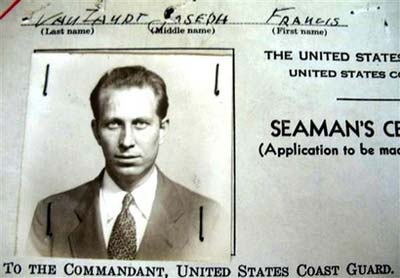
The remains belong to Francis Joseph Van Zandt, a 36-year-old merchant marine from Roanoke, Va., who was on a plane rumored to contain a cargo of gold when it smashed into the side of a mountain 60 years ago. Thirty people died in the crash. "This is the oldest identification of fingerprints by post-mortem remains," said latent fingerprint expert Mike Grimm Sr., during a teleconference Friday, during which the two pilots who found the remains, genetic scientists and genealogists talked about the discovery. Twenty-four merchant marines and six crewmen were flying from China to New York City on March 12, 1948, when the DC-4 slammed into Mount Sanford, perhaps because the pilots were blinded by an unusually intense aurora borealis that night. The wreckage disappeared into the glacier within a few days. The DC-4 was thought to be carrying gold because the merchant marines had just delivered an oil tanker to Shanghai. Though no gold was found, the two commercial airline pilots who discovered the wreckage found themselves on a scientific adventure filled with high-tech sleuthing. The pilots, Kevin McGregor and Marc Millican, discovered the mummified remains in 1999 while recovering artifacts to identify the wreckage they had found two years earlier. An Alaska State Trooper flew to the glacier to take possession of the remains, which were flown to Anchorage where the state medical examiner tried to obtain fingerprints. The remains then were embalmed. The Alaska Department of Public Safety attempted to match the fingerprints to numerous databases but came up empty because the details of the fingerprints were unclear. A few pieces of the arm were sent to a commercial DNA laboratory. However, no data could be obtained because the remains, having been in a frozen and dehydrated state for decades, were too degraded. In 2002, the arm and hand were sent to a DNA expert in Canada. Dr. Ryan Parr at Genesis Genomics in Thunder Bay was able to extract some DNA. However, it was still necessary to locate family members related to the victim for a mitochondrial DNA match. Mitochondrial DNA is DNA passed down by females. In 2006, Dr. Odile Loreille at the Armed Forces DNA Identification Laboratory in Rockville, Md., was asked to help. Her expertise is extracting DNA from the embalmed remains of unidentified soldiers from the Korean War. Loreille developed new methods that allowed her to read the hand and arm's mitochondrial DNA. "I managed to get a mitochondrial sequence," she said. "Now I just needed some relatives to compare." That's when forensic genealogist Dr. Colleen Fitzpatrick got involved in the frustrating search for living relatives of the victims. She and her assistants found family members of 16 of the victims, but no DNA matches. In the meantime, Grimm Sr., and his son, Mike Grimm Jr., began work with Edward Robinson, a professor of forensic science at George Washington University. Robinson made several attempts to rehydrate the fingers to raise the fingerprint swirls, but by this time only the layer of skin below the outer epidermal layer remained. Robinson tried again with a newly-developed rehydrating solution. The fingers were soaked in the fluid and examined hourly. Special imaging techniques then were used to produce a complete set of fully legible fingerprints. On Sept. 6, 2007, the prints were compared with some kept at the National Marine Center in Arlington, Va., and a match was found. In the meantime, Loreille confirmed the finding with nuclear DNA from a nephew of Van Zandt's. A genealogist also located a relative whose mitochondrial DNA matched the remains. |