WORLD> America

|
WORLD> America
|
|
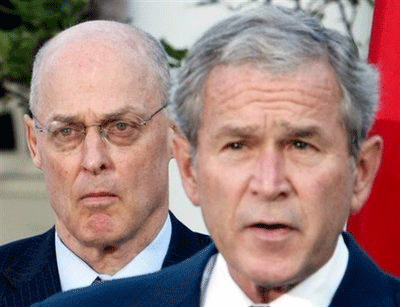
Bush, Paulson take new approach to economic crisis
(Agencies)
Updated: 2008-10-15 14:08 WASHINGTON - The Bush administration's latest effort to resolve the financial crisis embraces an approach it had resisted just a few weeks ago. But things move fast in the bailout world. And in deciding to inject fresh capital into US banks in return for ownership stakes, the administration adopted a plan that many leading economists had been pushing for weeks.
"I -- and many others -- have been harping on (the banks') inadequate capital for months," said Anil Kashyap, an economist at the University of Chicago's Graduate School of Business. The latest move follows a Herculean effort by Treasury Secretary Henry Paulson and Federal Reserve Chairman Ben Bernanke to win congressional approval last month of the $700 billion bailout package. That legislation will fund the recapitalization. But the focus of Paulson's initial plan -- buying distressed mortgage-related securities to improve banks' balance sheets and make it easier for them to lend again -- is now taking a back seat. The shift in approach suggests the administration had miscalculated the time it had to take corrective action before realizing the urgency of the crisis demanded the swiftest possible response. Scott Talbott, a lobbyist for the Financial Services Roundtable, an industry group, said he thinks last week's "plunge in the Dow" -- its worst ever -- convinced the Treasury Department that it needed to move faster. "Time is now of the essence," Ian Shepherdson, chief US economist for the consulting firm High Frequency Economics, wrote this week in a note to clients. "The authorities do not have the luxury of mulling over the fine details; they need to act now." Losses on mortgage-related securities have depleted bank capital. Those securities had collapsed in the face of falling home prices and rising defaults and foreclosures. Without sufficient capital, banks have been reluctant to lend, depressing economic activity. Some economists say Paulson initially opposed the notion of recapitalizing the banks partly out of a bias against government intervention in a private industry. The delay in taking that step "mostly seems to have been (due to) ideological blinders on Paulson's part," said Adam Posen, deputy director of the Peterson Institute for International Economics. When asked during congressional hearings three weeks ago about providing new capital to banks, Paulson dismissed the idea, saying he preferred "market mechanisms" like his proposal to remove troubled mortgage-related assets from banks' balance sheets. Government injection of capital "is about failure," he told members of the Senate Banking Committee. "This is about success." That argument seemed to be at odds with Federal Reserve economists, who favored government recapitalization of banks, Posen said. Bernanke was careful to note during a House hearing last month that the bailout legislation was "flexible" enough to let the government provide an injection if necessary. At the same time, Paulson faced a backlash from many Republicans in Congress who objected to the initial bailout plan and wanted a much smaller government role. Their rebellion contributed to the initial House rejection of the bailout on Sept. 29. Many of these lawmakers were suspicious of Paulson, privately voicing concern that he was too willing to push solutions to the crisis that violated the conservative credo of limited government and frugality with taxpayer dollars. Other Republicans, though, joined Democrats in prodding Paulson to consider taking equity stakes in financial institutions, on the theory that if government money was going to be used, taxpayers should at least get the chance eventually to profit from the investment. Rep. Roy Blunt of Missouri, the No. 2 Republican, noted Tuesday that even though Paulson initially opposed the idea, he has come to view it as a vital way to get money into banks faster than asset purchases could. "We're investing taxpayer money with an almost certain guarantee of return and profit," Blunt said. The administration's plans also put the United States in the unfamiliar position of following the lead of Britain and other European nations, which have already announced similar steps. That's another sharp reversal from several weeks ago, when many European officials opposed a systemic approach to the crisis and made clear they felt it was largely an American problem. "The Europeans look good, the Americans look terrible and it is a surprise, because the stereotype is the European Union can't get it together," Posen said. In part, the United States was forced to act after Britain said last week that it would recapitalize its banks, and 15 European governments followed suit over the weekend. If the United States hadn't fallen in line, US banks would have faced a significant competitive disadvantage against European banks, Posen said. "The Brits did us a big favor," Kashyap said. The US and European governments are now taking a consistent, if not fully coordinated, approach. That is something many economists had hoped for late last week, just before the G-7 group of wealthy countries met Friday and the International Monetary Fund and World Bank held their annual meetings over the weekend.
|