WORLD> Asia-Pacific

|
WORLD> Asia-Pacific
|
|
Scientists clone frozen mice, aim for mammoths
(China Daily)
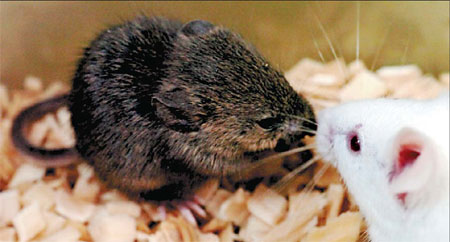
Updated: 2008-11-05 07:48 Japanese scientists have cloned mice whose bodies were frozen for as long 16 years and said on Monday it may be possible to use the technique to resurrect mammoths and other extinct species. Mouse cloning expert Teruhiko Wakayama and colleagues at the Center for Developmental Biology, at Japan's Riken research institute in Yokohama, managed to clone the mice even though their cells had burst.
"Thus, nuclear transfer techniques could be used to 'resurrect' animals or maintain valuable genomic stocks from tissues frozen for prolonged periods without any cryopreservation," their findings were published in the Proceedings of the National Academy of Sciences in the United States. A mouse used for cloning had been preserved at - 20 C, a temperature similar to frozen ground. Wakayama's team used the classic nuclear transfer technique to make their mouse clones. This involves taking the nucleus out of an egg cell and replacing it with the nucleus of an ordinary cell from the animal to be cloned. When done with the right chemical or electric trigger, this starts the egg dividing as if it had been fertilized by a sperm. "Cloning animals by nuclear transfer provides an opportunity to preserve endangered mammalian species," they wrote. "However, it has been suggested that the 'resurrection' of frozen extinct species (such as the woolly mammoth) is impracticable, as no live cells are available, and the genomic material that remains is inevitably degraded," they said. Digging into freezers Wakayama's team dug out some mice that had been kept frozen for years and whose cells were indisputably damaged. Freezing causes cells to burst and can damage the DNA inside. Chemicals called cryoprotectants can prevent this but they must be used before the cells are frozen. They tried using cells from several places and discovered that the brains worked best. This is a bit of a mystery, as no one has yet cloned any living mouse from a brain cell. Many animals have been cloned, starting with sheep, and including pigs, cattle, mice and dogs. Livestock breeders want to use cloning to start elite herds of desirable animals, and doctors want to use cloning technology in human medicine. "There is hope in bringing Ted Williams back, after all," cloning and stem cell expert John Gearhart of the University of Pennsylvania said. The family of Williams, the Boston Red Sox hitter, had his body frozen by cryogenics firm Alcor after he died in 2002. Gearhart was only half-joking and said the study "may now stimulate the small industry of freezing parts of us before we die to bring us back in the future". Mammoths may be the extinct animals that scientists would be most likely to try to clone, as many of the animals have been found preserved in ice. Akira Iritani, a mammoth expert at Kinki University in Osaka, said it was only a matter of time before researchers could find a mammoth for a resurrection project. "I have high hopes that we will be able to find a fine sample," he said. "It's said that there are more than 10,000 mammoths lying underneath Siberia." In July last year, Russian scientists discovered the body of a baby mammoth frozen in the Arctic Yamalo-Nenetsk region for as long as 40,000 years. Even if it is impossible to recreate a whole animal, the process could create cloned embryonic stem cells for extinct species, giving a boost to research on evolution and zoology, Iritani said. "It remains to be shown whether nuclei can be collected from whole bodies frozen without cryoprotectants and whether they will be viable for use in generating offspring following nuclear transfer," Wakayama's team wrote. Safety and ethics Cloning can be controversial in terms of both bioethics and, if the animals are eaten, food safety. Earlier this year, a report by the European Union warned that cloning can threaten the health of livestock. South Korea's parliament has passed a law to regulate research into cloning, following a scandal in which a now-disgraced expert falsely claimed to have made the first human clone stem cells.
|