WORLD> America

|
WORLD> America
|
|
A worried America chooses its course for change
(Agencies)
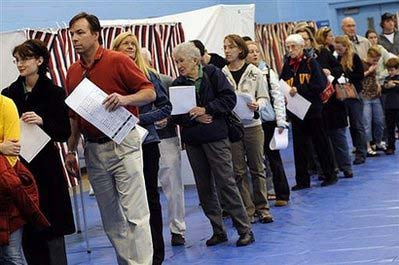
Updated: 2008-11-05 11:19 They came. They queued. They voted. Dawn to dusk, before work and after, in lines snaking around corners in all parts of the republic, Americans fretting about the direction of their nation startled even jaded poll workers as they flooded voting booths Tuesday. The overriding issue, early exit polls showed, was the economy. But the overriding sentiment was change.
From Dunbarton, N.H.: "Something isn't working right out there," said Mike Tanner, 48. who owns a beef jerky business.
From Louisville, Ky.: "I think that we need a new direction," said Al Bubala, 34. National exit polls for The Associated Press and TV networks showed that for about a third of voters charting the United States' course in the post-Bush era, change itself — and the candidates' ability to effect it — guided their choice the most. Among younger voters, the candidate who built his platform upon fundamental change from the beginning, Barack Obama, was the overwhelming choice. Six in 10 Americans considered their faltering economy to be the most pressing issue in the race between John McCain and Obama for the presidency — an unsurprising conclusion, given that nine in 10 said the economy is in bad shape. Fears about health-care costs and terrorism followed in short order. Since primary season and even before, many Americans have insisted — and been told by the candidates and the media — that Tuesday's election is the most important of their generation, their century, their lifetime. That message appeared to play out at polling places, where, after waiting for months, a fractious nation united in unusual electoral fervor to wait some more — in excess of three hours in some areas. In Hampton Township, outside Pittsburgh in the pivotal state of Pennsylvania, a line of three dozen extended out the door of the community center moments after voting began at 7 am. Similar scenes unfolded in places from Brooklyn, N.Y., to Dover, Del., to Pontiac, Mich. Ohio, another battleground state, appeared headed toward 80 percent turnout. And at universities in Florida, some voters saw the long lines and gave up. "I've never seen anything like this," said Patti Negri, overseeing elections at a polling place in Hollywood, Calif., where people were lined up when she arrived at 6 am. The obsession with change — a new course, new direction, new attitude — rang clear in comments from two diametrically opposed voters at the same polling place in downtown Milwaukee. From Obama voter Jordan Yost, 28, laid off a year ago: "It's time for a change, and McCain wasn't going to provide that. From McCain supporter Brian Dandoy, 34, a real-estate agent: "I don't think this 'change, change, change' that Obama keeps preaching, it's not going to happen the way he is saying." And one more tick for the change column came in this little number, tucked away in the exit poll results: After a race that at times became obsessed with the tension between fundamental change and job experience, just one in five voters said that experience was their top criterion for choosing a new president. "Experience is clearly overrated," said Natalie Davis, a political scientist at Birmingham-Southern University in Alabama. "We are seeing a sea change in what voters are really looking for." The focus on change comes after a campaign that brought a useful national chestnut back into play: the American vision of the future, which as a concept was a driving political force throughout much of the country's history. But it faded along with optimism during the Vietnam War and has largely stayed that way except for a brief "Morning in America" interlude during the Reagan years. "I really haven't felt this energy in an election since John Kennedy," said lawyer and lifelong Democrat Alejandro Soto, 64, of San Antonio. What else was important to Americans voting for president on Tuesday? Race, of course; virtually all blacks interviewed after leaving the polls said they had voted for Obama as the nation's first black chief executive. Presidential appointments to the Supreme Court were important for six in 10 voters, the exit polls showed. And affordable health care, an increasingly intense focus as the baby boomers age, worried two-thirds of voters, which drew 60 percent of them to Barack Obama. As Americans emerged from the polls, though, two words were conspicuously absent: George and Bush. The deeply unpopular leader dubbed by Jon Stewart "Still-President Bush" has laid low for weeks after being all but disowned by McCain, his own party's candidate. "I think the president is getting blamed for an awful lot of things that really aren't his fault," said Ron Kjellsen, 72, a McCain voter in Watertown, S.D. He added: "Not that he's the most competent president we've ever had." For months, pundits have argued about the nature of this presidential race: Is it about issues or personalities, about values or party politics? To look at the dozens of voters accosted for their opinions on Tuesday, one sad subject just kept re-emerging: Something's just not right. Consider Curt Babura, a 31-year-old cook in Cleveland who had never voted before. On Tuesday, he did, making his way to the polls on a silver, 10-speed bike. "I'm really kind of fed up with what's been going on in the country today," he said. "I wanted to make a difference this time. I think a lot of younger people are starting to realize the errors of our ways." Or listen to Joann Scherk, voting in Waterbury, Vt., and, seemingly, looking to find a hero. "It's gotten to the point where you don't really vote for someone as much as you vote against someone else," she said. "I wish it wasn't that way." And who did Scherk vote for — or, at least, against? Asked, she just wouldn't say. |