WORLD> America

|
WORLD> America
|
|
President-elect Obama reaches out to former rivals
(Agencies)
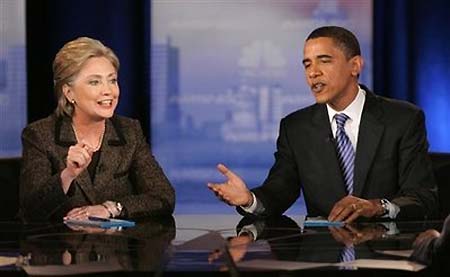
Updated: 2008-11-16 22:00 WASHINGTON – Presidents typically say they want to be surrounded by strong-willed people who have the courage to disagree with them. President-elect Barack Obama, reaching out to Hillary Rodham Clinton and Republicans, actually might mean it. Abraham Lincoln meant it. He appointed his bitter adversaries to crucial posts, choosing as war secretary a man who had called him a "long-armed ape" who "does not know anything and can do you no good."
Richard Nixon didn't mean it. "I don't want a government of yes-men," he declared. But among all the president's men, those who said no did so at their peril. He went down a path of destruction in the company of sycophants. It so happens that Obama and New York Sen. Clinton share a reverence for "Team of Rivals," Doris Kearns Goodwin's book about how Lincoln brought foes into his fold. Clinton listed it during the campaign as the last book she had read. Obama, clearly a student of Lincoln, spoke of it several times. Now past could be prologue.
"I think it reflects a great inner strength on Obama's part that he is seriously considering creating a team of rivals as Lincoln did," Goodwin told The Associated Press on Friday. "By surrounding himself with people who bring different perspectives, he will increase his options, absorb dissenting views and heighten his ability to speak empathetically to people on different sides of each issue. The challenge, of course, is to ensure that the discussions do not become paralyzing, and that once a decision is made the inner circle accepts that the time for debate is over," she said. During the bitter primary campaign, Clinton dismissed Obama as a neophyte who could not be trusted to handle crises and who had not done much more in politics than make fancy speeches. Obama sniffed that "you're likable enough, Hillary." Yet she strongly supported Obama in the general campaign, not unlike William Henry Seward, the Hillary Clinton of his day. Seward, the front-runner in the race for the 1860 Republican nomination, was so confident of taking the prize that he went on an eight-month tour of Europe a year earlier, only to see Lincoln vanquish him. Lincoln buried animosities and made him secretary of state. Lincoln also enlisted Democrat Edwin Stanton as his second war secretary, despite being humiliated by Stanton years earlier when they worked together as trial lawyers. Salmon P. Chase, a constant critic of Lincoln and another Republican rival, became his treasury secretary. Other rivals were put in the Cabinet, too. Lincoln's reasoning: "We needed the strongest men. These were the very strongest men. I had no right to deprive the country of their services." None of this has been lost on Obama, who said in May that Lincoln's inclusion of former foes "has to be the approach that one takes." At the time, he said he would consider McCain for the Cabinet if that made sense. Now, aides for both men say such a move is not in the works but they will seek other ways to cooperate. To be sure, the pledge to build a strong and politically diverse Cabinet of people who will not be cowed by the president and his aides is made in one election after another. It usually has all the staying power of a New Year's resolution. Michael Nelson, in his "Guide to the Presidency," noted that Jimmy Carter promised: "There will never be an instance while I am in office where the members of the White House staff dominate or act in a superior position to the members of the Cabinet." That didn't last long. Carter met weekly with his Cabinet in his first year, every two weeks in his second, monthly in his third and only sporadically in his fourth, Nelson calculated, tracing a typical pattern of good intentions lost in the wind. Walter Hickel, Nixon's interior secretary, thought the president valued his contrary views "because, to me, an adversary in an organization is a valuable asset." Not to Nixon. Hickel came to realize Nixon "considered an adversary an enemy." The two particularly disagreed over the Alaskan pipeline — the secretary wanted to protect wilderness lands coveted by the oil companies. During one testy meeting, he asked Nixon whether he should leave his administration. "He jumped from his chair, very hurried and agitated," Hickel recalled. "He said, 'That's one option we hadn't considered.'" A week later, Hickel was fired. Goodwin says a true team of rivals is exceptionally difficult to make work in these days of hyperpartisanship, scandal-hungry blogs and raw feelings between parties and factions of the same party from the often nasty campaign. Disharmony in Lincoln's Cabinet was largely kept inside the meetings, exposed years later in memoirs, and that's not how the world works anymore. Still, she said the even-keeled Obama displayed a temperament in the campaign that could help him pull it off. "And I believe the country would respond with great enthusiasm, recognizing the great contrast to recent times." Obama invited dissent in his election night victory speech, promising, "I will listen to you, especially when we disagree." It remains to be seen whether he wants naysaying of the kind delivered by Stanton, who served as Democrat James Buchanan's attorney general in one of the few instances in history when a Cabinet member from one party has gone on to serve a president of the other party in the succeeding administration. "You are sleeping on a volcano," he warned Buchanan in the lead-up to the Civil War. Without prompt action, "you will be the last president of the United States." He was no yes-man. |
|||||