WORLD> Africa

|
WORLD> Africa
|
|
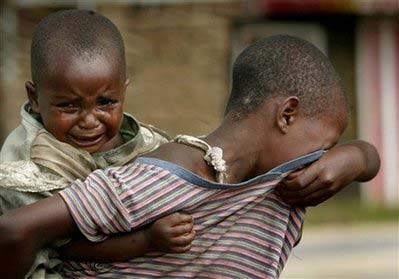
A photo of 2 little girls and a reunion in Congo
(Agencies)
Updated: 2008-11-19 10:22 KIWANJA, Congo – Eleven-year-old Protegee carried her sobbing niece on her back as they searched for relatives in a sea of people in eastern Congo. An Associated Press photograph of the girl — using her filthy T-shirt to wipe the tears from her face as 3-year-old Reponse clung to her neck and wailed — prompted hundreds of e-mails from people around the world hoping to help them.
I returned to Kiwanja on Sunday to try to reunite the girls with family and even succeeded in finding them. But it turned out that not all problems in Congo can be solved by an outsider's sympathy. When I first photographed Protegee on Nov. 6 in a crowd of thousands in the town of Kiwanja, she told me only her first name and that she was looking for her mother. I learned later that she and Reponse had wandered alone for three days after being separated from Protegee's mother on Nov. 3 as the family fled on foot from their village of Kiseguru, about 12 miles away. Protegee had spent one night sleeping in a church, huddled with Reponse under a flimsy scarf. "I had no food or water," she said, speaking in the Kiswahili language. Hundreds of children have been separated from their families since fighting flared in eastern Congo in August and more than 1,600 children in the province were seeking their parents last week alone, according to UNICEF. The children's young ages and inability to give detailed information — plus the lack of official records in the Congolese countryside — make it even more difficult to track down their families. When I set out to search for Protegee, I had little certainty of success but I was determined to try to help. As a journalist, I've photographed war and refugees all over the world since the early 1980s. But I was particularly moved by readers' reactions to this photograph of two little girls, their faces wrenched in fear and desperation. I knew that the chances of finding them again were slim, as I see children walking alone on the roads every day. But I found myself imagining how it would feel if I were searching for my own daughters — and having two, that was not difficult. Years of sporadic violence in eastern Congo intensified in August, and fighting between the army and fighters loyal to rebel leader Laurent Nkunda has displaced at least 250,000 people since then — despite the presence of the largest UN peacekeeping force in the world. Some fear Congo's current crisis could again draw in neighboring countries. Congo's devastating 1998-2002 war split the vast nation into rival fiefdoms and involved half a dozen African armies. Reaching Kiwanja meant crossing an uneasy front line just a few miles north of Goma, with hundreds of heavily armed rebels and government troops deployed on either side. Then it was a bone-jarring two-hour drive on what was once a paved road, and is now one giant pothole. Kiwanja is a typical African town, with one strip of dirt road as the main drag, a few small shops on each side, one roundabout, one crossroad, and huts sprawling to infinity on the hills to the east and the valley to the north. Armed with the photograph of Protegee and Reponse, I started asking around. Women frowned — they did not know the girls. I traveled to the school yard, to the clinic. No luck. As I was about to head back to Goma, I stopped near a U.N. base. Just a few days earlier its outskirts were refuge to thousands. But now it was a nearly empty lot with the skeletons of makeshift huts and a white UNHCR tent. I ventured inside the tent. There, Maria Mukeshimani's eyes lit up at the sight of the photo — the woman, who had been displaced herself by the violence, knew these children. She had seen them in that very tent five days earlier. And she knew Protegee's mother: Her name is Esperance Nirakagori. Esperance — the French word for hope. Esperance had taken refuge at the local Catholic church in Kiwanja. When I arrived there, I was greeted by the sounds of a choir. It was evening Mass. "Does anyone know if Esperance is around?" I asked. An elderly man replied that she was in a small house nearby. Wearing a yellow and red dress, Esperance greeted us. She had sweat dripping from her headscarf and spoke softly. I showed her the picture and she smiled at the sight of the girls. Then, to my surprise, she said they had already found her, but she had sent them back to their village, alone and on foot. She feared for their safety in Kiwanja and believed they would be more secure in the care of her elder daughter; she was too weak to make the journey herself. She kept staring at the photo. Only when I told her I would return the next morning and drive her to rejoin the girls in Kiseguru did her face light up in a wide, genuine smile. We set off the next day after stopping for food at a restaurant in town. Esperance was quiet as we drove the 20 minutes to the village. She clutched the girls' photo as she walked through the streets, a trail of excited children in her wake. The reunion with Protegee and Reponse, in a small mud hut, was brief. They smiled at each other. No one spoke. I prompted Protegee, a shy girl who was only 2 months old when her father was killed in Congo's last bloody war. "Are you happy to see your mother?" I asked. She answered, in a soft voice: "Yes." Protegee told how she had arrived exhausted in Kiseguru on Nov. 12. But when she did, she found her family's hut empty — her sister and other relatives had already fled toward Uganda. For five days she waited for an adult to come for her. No one did. She was planning to set off for Kiwanja that very day to rejoin her mother, when I arrived instead. Rather than remain in their village, Esperance asked me to take them all back to Kiwanja. In the streets of Kiseguru, we had seen 20 men wearing civilian clothes and toting Kalashnikovs. When I asked her who they were, her answer was swift and certain: "Mai Mai." Earlier this month, Kiwanja residents were terrorized by the pro-government Mai Mai militia, who the U.N. said killed people accused of supporting the rebels. Then the rebels won control and killed those they claimed had supported the militiamen. And now the Mai Mai were in her family's village. Protegee, Reponse and Esperance are back in Kiwanja now. They have set up a cot in the corner of a room on the Catholic church grounds. Outside, the UN World Food Program is distributing food, but the situation in the town remains volatile. Before I left, I gave Esperance the photograph of her daughter and granddaughter. She handed it to Protegee, who, with Reponse in her lap, gazed at the image. I left them there on their cot, clutching the photo, one of their few possessions. Asked when they would return to their village, Esperance replied: "When the war is over." |