WORLD> America

|
WORLD> America
|
|
Dow ends up nearly 400 after bailout of Citigroup
(Agencies)
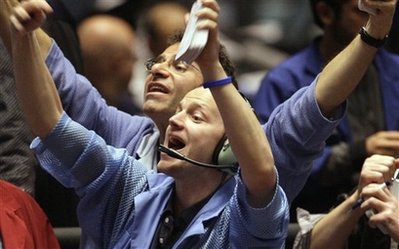
Updated: 2008-11-25 09:21 NEW YORK -- The government's plan to bail out Citigroup sent Wall Street soaring Monday for the second straight session as investors hoped that the worst of the financial industry's problems might finally be over. The Dow Jones industrials surged nearly 400 points, and all the major indexes jumped more than 4.5 percent.
The rally gave the market its first two-day advance in three weeks and the Dow its biggest two-day percentage gain since October 1987, the month of the Black Monday crash. The Dow's 891-point climb over the two sessions also wiped out the 872-point plunge it suffered on Wednesday and Thursday, when investors were anguished over the fate of Citigroup Inc. and financial companies in general, and the future of the nation's automakers. Although investors sensed late last week that a rescue of Citigroup was forthcoming, they nonetheless were heartened, even emboldened, by the US government's decision late Sunday to invest $20 billion in the company and guarantee $306 billion in risky assets. Wall Street's enthusiasm grew not only because the bailout answered questions about Citigroup but also because many observers saw the move as offering a model for how the government might stabilize other banks. "The government has taken a new quill out," said Scott Bleier, founder of market advisory service CreateCapital.com. "They've gone to where they didn't go before in terms of trying to secure the system. Some of that vulnerability seems to be gone now." Still, the market remained wary, especially with the economy in a serious downturn. The Dow was up more than 500 points in the last hour before giving up some of its gains. Many investors wanted to take some money off the table before any bad news arrived. And the market has frequently done sharp reversals since the start of the credit crisis 15 months ago. The efforts by the Treasury Department, the Federal Reserve and the Federal Deposit Insurance Corp. to help stabilize Citigroup are only the latest this year to support a banking system troubled by bad debt and flagging confidence. Besides its $700 billion bailout plan for the financial industry, the government has bailed out insurance giant American International Group Inc. and taken over lenders Fannie Mae and Freddie Mac. "You're definitely seeing relief," said Anthony Conroy, managing director and head trader for BNY ConvergEx Group. "More than anything, the Fed repaired some of the psychological damage that was being done to the sector. I think the Fed is poised to do whatever they possibly can to help the financials get through the current turmoil." "Not all banks are unhealthy, so knowing that the Fed is there is enough," Conroy said. The Dow rose 396.97, or 4.93 percent, to 8,443.39. Its last two-day advance was Oct. 30 and 31, along with the rest of the market. Broader stock indicators also jumped. The Standard & Poor's 500 index advanced 51.78, or 6.47 percent, to 851.81, and the Nasdaq composite index rose 87.67, or 6.33 percent, to 1,472.02. The Russell 2000 index of smaller companies rose 30.25, or 7.44 percent, to 436.79. Over the course of Friday and Monday, the Dow rose 11.8 percent, while the broader S&P 500 index jumped 13.2 percent. The Nasdaq rose 11.9 percent. Paper gains in US stocks over the two sessions came to $1.2 trillion, according to the Dow Jones Wilshire 5000 Composite Index, which reflects nearly all stocks traded in America. "I think it's a little bit of confidence coming back into the system right now," said Harry Clark, chief executive of Clark Capital Management. He contends the market began to form a bottom after an eight-day selloff that ended Oct. 10, and on Thursday made further headway toward setting a low that could give way to a rally. |