WORLD> Asia-Pacific

|
WORLD> Asia-Pacific
|
|
Japanese youth face job woes
(Agencies)
Updated: 2008-12-03 08:02 University students in the world's second-largest economy could face a rude awakening as the global financial crisis hits Japan, prompting firms to cut graduate recruitment.
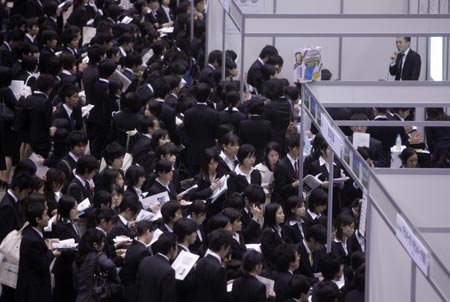
"Students last year didn't have any trouble finding jobs, but the situation seems to have suddenly changed this year," said Junya Kubota, 21, one of 25,000 nervous third-year college students at a recent weekend career forum in Tokyo. "I'll have to make an effort, visiting companies and looking out for jobs on the Internet," said Kubota, wearing standard job seekers' attire of a black-suit-and-tie as he joined others collecting brochures and taking notes at lectures by speakers from Toshiba, Sharp and other corporations. Japanese companies, once flush with cash and desperate to fill a gaping hole from retiring baby-boomers, have enticed university students in recent years with generous vacations, free i-Pods and monthly allowances for pets. But after four years of aggressive hiring, the tide has turned. Many firms are contemplating cutting hiring and some have even retracted job offers to final year students, sending them scrambling for new employers. "The students are in shock," said Hiroshige Sugibayashi, a career adviser at Tokyo's Meiji University, where four students recently had job offers revoked. "We're giving them psychological support, but they have to start looking for work all over again and it's not going to be easy." The prospect of unemployment also looms over students starting their studies as economists predict Japan's recession might be protracted, perhaps even the longest on record, as global demand for Japanese cars and technology dries up. Still, students could be spared the sort of hiring freeze seen during Japan's 1994-2004 "Ice Age" after the bursting of an asset price bubble, when many companies slashed recruitment to zero. "Our company didn't hire anyone from 1994-97, and again in 2001, but as a result, we now have a shortage of staff in their late 30s to take up managerial positions," said Tanaka at Keio Department Store. "We want to continue hiring, even if it's less," he said, echoing other employers who complained of a dearth of younger staff to train incoming hires. Job offers for college graduates for 2009 are down 1.4 percent compared with those who started work this year, the first decline in five years, a survey of big firms by the Nikkei business daily showed. And among those with job offers, over 300 have had the offers revoked or were at risk of having them revoked because companies no longer wanted to hire, data from the Ministry of Health, Labour and Welfare showed. The figure was the highest since 1998. 'Ice Age' rerun? Keio Department Store, a Tokyo retailer at the jobs fair, was looking to hire 20 new graduates in 2010, down from 30 in recent years, according to Masaaki Tanaka, a recruiting manager. Others were vague about recruiting plans, but analysts said bigger companies, known to hire new graduates en masse every spring, were expected to scale back hiring as earnings fall and uncertainties loom over the recession-hit economy. Politicians facing an election that must be held in less than a year are putting the problem on their policy agenda. "New employment for those who graduate the year after next is already shrinking," said Kazuo Kitagawa, a senior executive in the ruling coalition's junior partner, the New Komeito party. "Those students are feeling anxious and we need to have proper policy steps to address this," he said. Japan's jobless rate is at 3.7 percent, well below a record high of 5.5 in April 2003, although officials say that the fall is partly due to discouraged workers leaving the workforce. Japan's rapidly ageing population also means the number of those retiring will outnumber those coming in, relieving companies of labour costs and making any job crunch much less severe than in the past.
|