WORLD> America

|
WORLD> America
|
|
Toxic coal ash piling up in ponds in 32 US states
(Agencies)
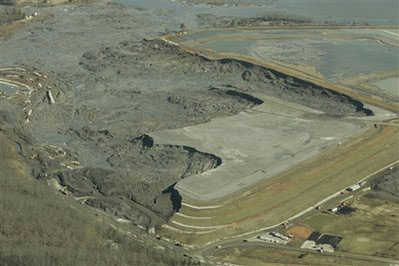
Updated: 2009-01-09 20:13 WASHINGTON – Millions of tons of toxic coal ash is piling up in power plant ponds in 32 American states, a practice the federal government has long recognized as a risk to human health and the environment but has left unregulated. An Associated Press analysis of the most recent Energy Department data found that 156 coal-fired power plants store ash in surface ponds similar to the one that collapsed last month in Tennessee.
Records indicate that states storing the most coal ash in ponds are Indiana, Ohio, Kentucky, Georgia and Alabama. The man-made lagoons hold a mixture of the noncombustible ingredients of coal and the ash trapped by equipment designed to reduce air pollution from the power plants. Over the years, the volume of waste has grown as demand for electricity increased and the federal government clamped down on emissions from power plants. The AP's analysis found that in 2005, the most recent year data is available, 721 power plants generating at least 100 megawatts of electricity produced 95.8 million tons of coal ash. About 20 percent — or nearly 20 million tons — ended up in surface ponds. The remainder ends up in landfills, or is sold for use in concrete, among other uses. The Environmental Protection Agency eight years ago said it wanted to set a national standard for ponds or landfills used to dispose of wastes produced from burning coal. The agency has yet to act. As a result, coal ash ponds are subject to less regulation than landfills accepting household trash. The EPA estimates that about 300 ponds for coal ash exist nationwide. And the power industry estimates that the ponds contain tens of thousands of pounds of toxic heavy metals. Without federal guidelines, regulations of the ash ponds vary by state. Most lack liners and have no monitors to ensure that ash and its contents don't seep into underground aquifers. "There has been zero done by the EPA," said Rep. Nick Rahall, D-W. Va., chairman of the House Natural Resources Committee. Rahall pushed through legislation in 1980 directing the EPA to study how wastes generated at the nation's coal-fired power plants should be treated under federal law. In both 1988 and 1993, the EPA decided that coal ash should not be regulated as a hazardous waste. The agency has declined to take other steps to control how it is stored or used. Rahall plans to introduce legislation this Congress to compel the EPA to act. "Coal ash impoundments like the one in Tennessee have to be subject to federal regulations to ensure a basic level of safety for communities," Rahall said. At a hearing held Thursday on the Tennessee spill, Senate Democrats called for stricter regulations. "The federal government has the power to regulate these wastes, and inaction has allowed this enormous volume of toxic material to go largely unregulated," said Sen. Barbara Boxer, D-Calif., who chairs Senate committee that oversees the EPA. The agency says it is working toward a national standard and that there has been no "conscious or clear slowdown" by Bush administration officials who have run the agency since 2001 and often sided with the energy industry on environmental controls. "It has been an issue of resources and a range of pressing things we are working on," said Matthew Hale, who heads the agency's Office of Solid Waste. Over the years, the government has found increasing evidence that coal ash ponds and landfills taint the environment and pose risks to humans and wildlife. In 2000, when the EPA first floated the idea of a national standard, the agency knew of 11 cases of water pollution linked to ash ponds or landfills. In 2007, that list grew to 24 cases in 13 states with another 43 cases where coal ash was the likely cause of pollution. The leaks and spills are blamed for abnormalities in tadpoles. The heads and fins of certain fish species were deformed after exposure to the chemicals. In 2006, the EPA concluded that disposal of coal waste in ponds elevates cancer risk when metals leach into drinking water sources. Among the facilities listed by the EPA as potentially causing environmental damage were three run by the Tennessee Valley Authority, the same utility that operates the pond in Tennessee that failed last month. Hale said the national standard would require monitoring for leaks at older, unlined sites and require the company to respond when they occur. The industry already runs a voluntary program encouraging energy companies to install groundwater monitors. Industry officials argue that a federal regulation will do little to prevent pollution at older dump sites. "Having federal regulations isn't going to solve those problems," said Jim Roewer, executive director of the Utility Solid Waste Activity Group, a consortium of electricity producers based in Washington. "What you have to look at is what the current state regulatory programs are. The state programs continue to evolve." Despite improvements in state programs, many states have little regulation other than requiring permits for discharging into waterways — as required by the federal Clean Water Act. In North Carolina, where 14 power plants disposed of 1.3 million tons in ponds in 2005, state officials do not require operators to line their ponds or monitor groundwater, safety measures that help protect water supplies from contamination. Similar safety measures are not required in Kentucky, Alabama, and Indiana. And while other states like Ohio have regulations to protect groundwater, those often don't apply to many of the older dumps built before the state rules were imposed. Government enforcement has been spotty, leaving citizens who suffered from the contamination to file lawsuits against power companies. In May, the owners of a Montana power plant — storing more ash in ponds than any other facility in the country — agreed to pay $25 million to settle a lawsuit filed by 57 plant workers and nearby residents. The plant's ponds were blamed for contaminating water supplies in subdivisions and a trailer park. Many of the ponds at the Colstrip, Mont., plant were in place before regulation. State environmental officials say the operator, PPL Montana, is working to fix leaks. Just last week, a judge in Baltimore approved a $54 million lawsuit settlement against a subsidiary of Constellation Energy. The company was accused of tainting water supplies with coal ash it dumped into a sand and gravel quarry. Neither of these made the EPA's 2007 list of 67 cases of known or possible contamination stemming from power plant landfills or holding ponds. "The solution is readily available to the EPA," said Lisa Evans, an attorney for Earthjustice, an environmental advocacy group. "We wouldn't like it, but they could say that municipal solid waste rules apply to coal ash. They could have done that, but instead they chose to do absolutely nothing." |