WORLD> America

|
WORLD> America
|
|
New details about flight's Hudson River landing
(Agencies)
Updated: 2009-01-18 10:29 NEW YORK -- Investigators provided a dramatic new account Saturday of what unfolded inside US Airways Flight 1549 when it slammed into a flock of birds moments after takeoff and lost both engines. Within seconds, the pilot knew where he would end up: "We're gonna be in the Hudson."
The account by the National Transportation Safety Board demonstrates just how quickly the flight deteriorated from a routine takeoff to a perilous crash-landing. It began with a thump at about 3,000 feet and the loss of all engine noise, followed by the pilots' quick realization that returning to LaGuardia or finding another airport was impossible.
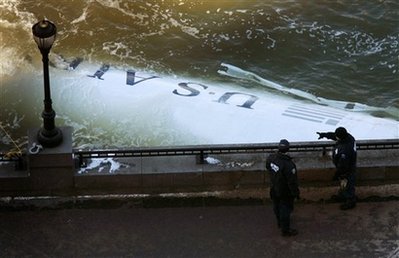
The blow had come out of nowhere. The NTSB said radar data confirmed that the aircraft intersected a group of "primary targets," almost certainly birds, as climbed over the Bronx. Those targets had not been on the radar screen of the air traffic controller who approved the departure, NTSB board member Kitty Higgins said. As the details emerged, investigators interviewed the pilots and worked to pull the airliner from the river. The jet lay almost entirely submerged Saturday next to a sea wall in lower Manhattan where workers positioned a crane to haul it onto a waiting barge. Crews need to remove the cockpit voice and flight-data recorders and locate the left engine, which came off and floated away following the crash-landing. Divers originally thought both engines were lost, but realized Saturday that the right engine was still attached. The water had been so dark and murky that they couldn't see it. The conditions were treacherous, with the temperature dipping to 6 degrees and giant chunks of ice forming around the plane by midday. Divers who went into the river had to be sprayed down with hot water during breaks on shore. Teams worked into the evening to remove the plane, with floodlights shining down onto the scene and emergency boats surrounding the aircraft. The investigation played out as authorities released the first video showing the spectacular crash landing. Security cameras on a Manhattan pier captured the Airbus A320 as it descended in a controlled glide, then threw up a spray as it slid across the river on its belly. The video also illustrated the swift current that pulled the plane down the river as passengers walked out onto the wings and ferry boats moved in for the rescue. Authorities also released a frantic 911 call that captured the drama of the flight. A man from the Bronx called 911 at 3:29 pm Thursday, three minutes after the plane took off. "Oh my God! It was a big plane. I heard a big boom just now. We looked up, and the plane came straight over us, and it was turning. Oh my God!" the caller said. At almost the same moment, the pilot told air-traffic controllers that he would probably "end up in the Hudson." Investigators began interviewing the pilot, Chesley B. "Sully" Sullenberger, and his co-pilot for the first time Saturday. Sullenberger guided the crippled aircraft into the river on Thursday afternoon, saving the lives of all 155 people on board. Sullenberger was seen entering a conference room of a lower Manhattan hotel, surrounded by federal investigators. The silver-haired pilot was wearing a white shirt and slacks and seemed composed. When a reporter approached him for comment, one of the officials responded: "No chance." His wife, Lorrie Sullenberger said "the enormity of the situation" had only begun to sink in Friday night as she watched the news. "It was actually the first time that I cried since the whole incident started," she said on "The Early Show" on CBS. She suggested the happy ending was good for the country. "I think everybody needed some good news, frankly," she said. Experts say the threat that birds have long posed to aircraft has been exacerbated by two new factors over the past 20 years: Airline engines have been designed to run quieter, meaning that birds can't hear them coming, and many birds living near airports have given up migrating because they find the area hospitable year-round. Canada geese, one of the most dangerous birds for aircraft, historically migrate not because of cold but a lack of food. Winter weather kills the grass they eat and sources of fresh water freeze over. But in developed areas, there is often both food and grass year round, found in parks and golf courses. And there isn't much that be done in the engineering of jet engines to armor them against a strike without hurting their ability to generate thrust. The most vulnerable part of the engine is the fan, which can be bent or smashed by an ingested bird. Pieces of busted blade then rip through the rest of the engine like shrapnel. Engines have been fortified so that they can stay intact in the event of such a strike, but they usually cannot be restarted once they are damaged, said Archie Dickey, an associate professor of aviation environmental science at Embry-Riddle Aeronautical University's campus in Prescott, Ariz. He said hits hard enough to cause a total failure are rare, only happening two or three times a year worldwide. "That's extremely rare," Dickey said. "The chance of it hitting both engines, I'd guess it is less than 1 percent." Most bird strikes happen within five miles of an airport, lower than 1,000 feet, as planes are taking off or landing. Aircraft hit thousands of birds every year, but they usually bounce off harmlessly. The US Airways flight hit the birds at 3,000 feet, the NTSB says. That caused a total engine failure, and the plane hit the river 3 1/2 minutes later. "Brace! Brace! Head down!" the flight attendants shouted to the passengers. Then, they were in the water. The flight attendants likened it to a hard landing -- nothing more. There was one impact, no bounce, then a gradual deceleration. "Neither one of them realized that they were in the water," Higgins said. The plane came to a stop. The captain gave a one-word command, "Evacuate." |
||||||