WORLD> Asia-Pacific

|
WORLD> Asia-Pacific
|
|
India's textile sector faces life or death struggle
(Agencies)
Updated: 2009-01-20 16:34 NOIDA, India – Neeraj Bhasin's basement factory outside New Delhi is dark and dingy, but there's just enough light to see the dust that has accumulated on the order catalogues sitting on his desk.
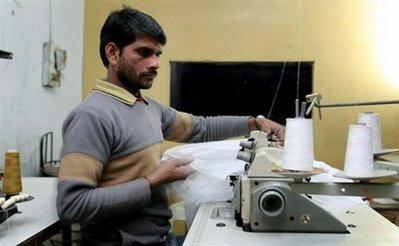
At one time Bhasin's 22-year-old textile export company, Eastern Connexion Exports, received regular orders for home furnishings from France, Spain and Scandinavia. But the economic meltdown in the major export markets of Europe and the US has led to a substantial fall in foreign orders and could be the final nail in the coffin for many of India's small- and medium-sized textile houses. Now the colourful organza curtains, floor cushions and quilt covers that were once produced in bulk sit in boxes and are piled high on tables as the company's profits have steadily shrunk. The global financial crisis is more grim news for India's second-largest industry, which has already seen 700,000 workers laid off and is set to shed another 500,000 jobs in the next five months, industry and government figures show. The textile sector employs almost 38 million workers and accounts for eight percent of India's GDP. In 2007-08 it was worth 22 billion dollars, but even before demand in the US and Europe started falling, the high value of the rupee and a spike in the cost of raw materials left textile exports more vulnerable than other sectors. Industry representatives responded coolly to a government stimulus package announced in December, which included a four percent cut in value-added tax aimed at bringing textile prices down. They said such packages would do little to stem the decline in demand in major export markets caused by the economic slowdown. "This doesn't really get addressed by any new investment," said Subir Gokarn, chief economist of Standard and Poor's Asia-Pacific division. New economic packages help companies see through the recession by allowing them to hold on to cash they already have or by injecting short-term liquidity, said Gokarn. "That's some relief but it's not going to make up for the fact that markets are in very sluggish conditions," he said. Entire Sector in Danger R.K. Dalmia, chairman of the Confederation of Indian Textile Industry, said the government should give textile companies some debt relief during this crisis or else there could be a sector-wide default on loan repayments. "We are not asking for any bailout package like the US and other countries. We are asking the government to give us certain benefits which are legitimate to our industry," Dalmia said. Bhasin was less than enthusiastic about relief packages. "If I don't have the business why would I need the credit?" he asked. Bhasin said he has seen his business survive a few downturns in years in business but this is "definitely the longest" period. At its peak, Eastern Connexion employed up to 700 people representing every socio-economic level, from shop floor workers to quality control specialists. His four-storey factory in the New Delhi suburb of Noida once bustled with more than 150 workers, but hard times have forced him to rent out every floor except the basement, where only 15 employees remain. Inside, a lone worker, Babli, sits at one of the six sewing tables, snipping away at sheer white fabric. He said he has worked in Bhasin's factory for 14 years, and while he is aware of the problems in other countries that have affected his work, he is hopeful that he will still be able to support his wife and three children. "The company is still going," said Babli while fiddling with a tape measure around his neck. "There are problems, but it's in God's hands." He said he worries his friends working in the same sector will have to return to unemployment in their villages if work in the city dries up. Much of India's textile industry is still traditional, relying on manual work in rural areas in Punjab, Gujarat and southern India, but there is plenty of work in urban centres to employ villagers. Job Losses on the Horizon If things keep going the way they are, Bhasin said he may have to call it a day and let go of loyal employees like Babli. "I'm not going to be running myself into the ground just because I've set up an industry," said Bhasin. "Whether or not I want to do anything for them, I can't." Bhasin said he had considered shifting his focus to the domestic textile market, which makes up 50 percent of all demand. But poor infrastructure and problems in collecting payment from Indian retail buyers leave little incentive for him to restructure. And trying to look for new textile markets outside the US and Europe is also fruitless. "All of the other countries to whom you could think of exporting are also major exporters themselves, so this is a very unique problem for the textile sector," said Gokarn, referring to Bangladesh, Vietnam and China. He said markets would have to improve within six months or so because "beyond that it's very difficult to keep unviable businesses up for very long". Bhasin hasn't given himself a time-frame for waiting out the recession, but is pessimistic. "When you have to sustain yourself over a long period of time, there is a breaking point," he said. |