WORLD> Global General

|
WORLD> Global General
|
|
Most extreme gamma-ray blast seen
(Agencies)
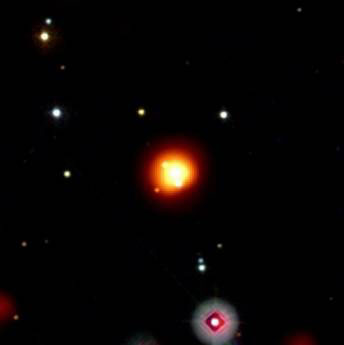
Updated: 2009-02-21 09:30 WASHINGTON – The US space agency's Fermi telescope has detected a massive explosion in space which scientists say is the biggest gamma-ray burst ever detected, a report published Thursday in Science Express said.
The spectacular blast, which occurred in September in the Carina constellation, produced energies ranging from 3,000 to more than five billion times that of visible light, astrophysicists said. "Visible light has an energy range of between two and three electron volts and these were in the millions to billions of electron volts," astrophysicist Frank Reddy of US space agency NASA said. "If you think about it in terms of energy, X-rays are more energetic because they penetrate matter. These things don't stop for anything -- they just bore through and that's why we can see them from enormous distances," Reddy said. A team led by Jochen Greiner of Germany's Max Planck Institute for Extraterrestrial Physics determined that the huge gamma-ray burst occurred 12.2 billion light years away. The sun is eight light minutes from Earth, and Pluto is 12 light hours away. Taking into account the huge distance from earth of the burst, scientists worked out that the blast was stronger than 9,000 supernovae -- powerful explosions that occur at the end of a star's lifetime -- and that the gas jets emitting the initial gamma rays moved at nearly the speed of light. "This burst's tremendous power and speed make it the most extreme recorded to date," a statement issued by the US Department of Energy said. Gamma-ray bursts are the universe's most luminous explosions, which astronomers believe occur when massive stars run out of nuclear fuel and collapse. Long bursts, which last more than two seconds, occur in massive stars that are undergoing collapse, while short bursts lasting less than two seconds occur in smaller stars. In short gamma-ray bursts, stars simply explode and form supernovae, but in long bursts, the enormous bulk of the star leads its core to collapse and form a blackhole, into which the rest of the star falls. As the star's core collapses into the black hole, jets of material blast outward, boring through the collapsing star and continuing into space where they interact with gas previously shed by the star, generating bright afterglows that fade with time. "It's thought that something involved in spinning up and collapsing into that blackhole in the center is what drives these jets. No one really has figured that out. The jets rip through the star and the supernova follows after the jets," Reddy said. Studying gamma-ray bursts allows scientists to "sample an individual star at a distance where we can't even see galaxies clearly," Reddy said. Observing the massive explosions could also lift the veil on more of space's enigmas, including those raised by the burst spotted by Fermi, such as a "curious time delay" between its highest and lowest energy emissions. Such a time lag has been seen in only one earlier burst, and "may mean that the highest-energy emissions are coming from different parts of the jet or created through a different mechanism," said Stanford University physicist Peter Michelson, the chief investigator on Fermi's large area telescope. "Burst emissions at these energies are still poorly understood, and Fermi is giving us the tools to understand them. In a few years, we'll have a fairly good sample of bursts and may have some answers," Michelson said. The Fermi telescope and NASA's Swift satellite detect "in the order of 1,000 gamma-ray bursts a year, or a burst every 100,000 years in a given galaxy," said Reddy. Astrophysicists estimate there are hundreds of billions of galaxies. The Fermi gamma-ray space telescope was developed by NASA in collaboration with the US Department of Energy and partners including academic institutions in France, Germany, Italy, Japan, Sweden and the United States. |