WORLD> America

|
WORLD> America
|
|
NASA: Shuttle moves to avoid space junk
(Agencies)
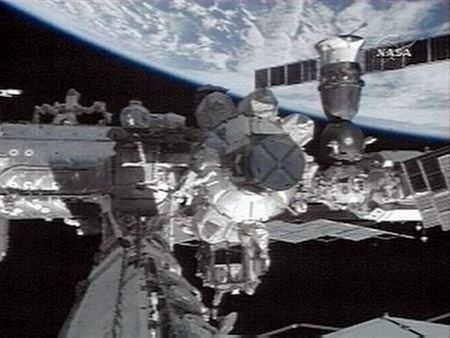
Updated: 2009-03-23 09:50 CAPE CANAVERAL, Fla. -- Confronted with orbiting junk again, NASA ordered the astronauts aboard the linked space station and shuttle Discovery to move out of the way of a piece of debris Sunday.
Mission Control said keeping the spacecraft in this position for about three hours, with Discovery's belly facing forward, would result in a slow, natural drag of about a foot per second, enough to get the complex out of the way of the 4-inch piece of junk. Space junk has been a recurring problem for the space station, especially recently. Earlier this month, the three space station residents had to take shelter in their emergency getaway capsule when another piece of orbital debris seemed like it might come too close. And just last week, right before Discovery's arrival, the space station almost had to dodge yet another piece of junk. The debris, from an old busted-up Soviet satellite, stayed at a safe distance. "Space debris is becoming an ever-increasing challenge," flight director Kwatsi Alibaruho said Sunday evening. When it comes to dodging junk, "It's a big deal. It's very tiring. Sometimes it's exhausting." The latest episode occurred as NASA scrambled to put together a spacewalking repair plan for a jammed equipment platform at the space station. "That was certainly exciting," Alibaruho said, chuckling. On Monday, on the third and final spacewalk of Discovery's mission, astronauts plan to return to an equipment storage shelf that jammed and could not be deployed Saturday. The spacewalkers accidentally had inserted a pin upside down. On Sunday, Alibaruho said the catch for the mechanism is considerably stiffer than expected and engineers now believe the upside-down pin might not be the culprit after all. Monday's spacewalkers, former schoolteachers Joseph Acaba and Richard Arnold II, will use all their strength this time to get the shelf properly deployed. They will have pry bars and hammers, just in case. If nothing works, the jammed platform will simply be tied down with sturdier tethers. A hastily assembled team of experts spent Saturday night and much of Sunday trying to figure out how best to deal with the problem. The storage platform, located on the long space station framework that holds all the solar wings, is meant to secure big spare parts that don't fit inside the space station but will be needed once NASA's shuttles stop flying. Because of all the pin trouble Saturday, the astronauts did not have time to deploy additional shelving on the opposite side of the station. That work was bumped to Monday's spacewalk. Despite the recent incidents, Discovery's astronauts said they don't worry about space junk when they're outside. "We have enough other risks and worries to take on as we go outside," said Steven Swanson, who took part in the first two spacewalks. One item on Sunday afternoon's agenda, a slow day for both crews, with time off, was a full test of a urine processor that was delivered by Discovery. There were hiccups, unfortunately, that the astronauts were trying to resolve. The urine processor is a critical part of the space station's new water-recycling system, which NASA would like to get working before the population at the orbiting outpost doubles to six at the end of May. The system, which arrived in November, is designed to convert astronauts' urine and condensation into drinking water. |