WORLD> America

|
WORLD> America
|
|
Feds unveil plan to sop up bad bank assets
(Agencies)
Updated: 2009-03-23 23:19 WASHINGTON – The Obama administration, striving to ease lending in the struggling economy, moved Monday with private investors to sop up bad bank assets. The administration said the program could grow to $1 trillion in purchases eventually, if it proves successful in attacking the bad-books problem that has been at the heart of the banking crisis.
In a lengthy fact sheet, the administration said it plans to use $75 billion to $100 billion from the government's existing $700 billion bailout program for this purpose, and it predicted participation from a broad array of investors ranging from pension funds and insurance companies to hedge funds.
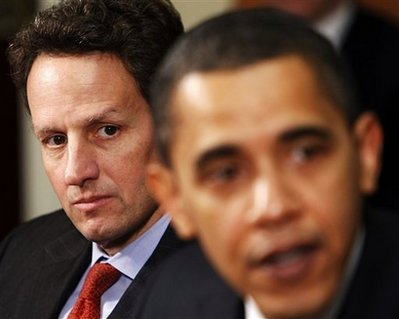
In one example used in the fact sheet, the purchase of a batch of bad mortgage loans would see the private investor put up 6 percent of the cost with the rest provided by the government, with the FDIC covering 84 percent of the cost with a loan and the remaining 6 percent coming from funds from the $700 billion bailout program. Stocks were pointing to a sharply higher opening Monday as investors began getting details of the new program. That offered a sharp contrast to the reaction that Treasury Secretary Timothy Geithner got on Feb. 10 when he unveiled the new administration's first bailout initiative. Investor disappointment sent the Dow Jones industrial average crashing by 380 points that day. Geithner's unveiling of the new program was taking place Monday morning at the Treasury Department with an off-camera briefing. President Barack Obama was scheduled to discuss the program later in the day. In opinion piece in Monday's Wall Street Journal, Geithner said the new program was designed to "resolve the crisis as quickly and effectively as possible at the least cost to the taxpayer. ... Simply hoping for banks to work these assets off over time risks prolonging the crisis." "This has never been about helping Wall Street or helping a firm that made mistakes," Christina Romer, head of the Council of Economic Advisers, said Monday. "It's absolutely about helping a system so that people can get their student loans, and that families can buy their house and buy their cars, and small businesses can get their loans." To encourage investors to be more supportive, the government is offering sizable financial enticements, from shouldering much of the financial risk to providing low-interest loans to purchase the assets. But the program is coming after a week of Wall Street-bashing in Congress, where lawmakers were outraged with the action by troubled insurance company American International Group Inc. to distribute $165 million in bonuses after obtaining more than $170 billion in government bailouts to remain in business. Some hedge funds and other investors have expressed reluctance to participate in the new program for fear that Congress will subject them to what they view as onerous restrictions on executive compensation. But administration officials insisted that they believe they have found the right mix to attract private investors and make a dent in what, by some estimates, could be more than $2 trillion in troubled assets on banks' books. They said the program has the capacity to purchase $500 billion and possibly as much as $1 trillion in troubled loans, which go back to the collapse of the housing boom and the subsequent tidal wave of foreclosures. But private analysts believe that with the $700 billion bailout fund nearly tapped out by capital injections to banks and lifelines provided to the auto companies and AIG, there are only enough resources left to get the asset purchase program launched. |
||||||