WORLD> Europe

|
WORLD> Europe
|
|
Quake-prone Italy lags in quake-proofing buildings
(Agencies)
Updated: 2009-04-08 11:11 ROME -- Italy is one of the most earthquake-prone countries in the world, but the vast majority of buildings in its most vulnerable regions don't meet modern seismic safety standards, experts say. Scientists say that is why Monday's temblor near L'Aquila took such a devastating toll.
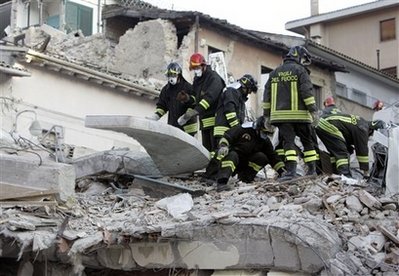
Apartment houses pancaked, church steeples toppled, part of a hotel collapsed, a college dormitory crumbled, a hospital was left largely unusable and a government headquarters that should have been helping to coordinate rescue efforts fell down. More than 200 people died in the quake that struck at 3:32 am with a magnitude of 6.3, according to the US Geological Survey.
Nearly half of Italy is labeled "dangerous" in terms of seismic activity, according to a 2008 report by Boschi and other Italian geologists and civil protection experts. But only 14 percent of buildings in that vulnerable swath were built to seismic-safety standards, the report said. One of the worst damaged structures in L'Aquila was the university dormitory, only a few decades old, where three students died and four others were missing and feared dead. At L'Aquila's hospital, patients had to be evacuated because the quake rendered it unsafe just when the facility could have been treating some of the 1,500 injured in the town and surrounding areas. Paolo Rocchi, a Rome-based architect who helped save St. Francis Basilica in Assisi after that church was heavily damaged in a 1997 quake, called the partial collapse of L'Aquila's hospital "absurd," considering that Monday's temblor didn't pack, as he put it, "hyper-destructive" power. Rocchi told the business newspaper Il Sole 24 Ore that the hospital, built less than 15 years ago, should have followed standards adopted after deadly quakes like the 1980 temblor that hit Naples. With authorities' concentrating on helping the thousands of homeless, it was too soon to know why the hospital succumbed. Rocchi raised the possibility, as has happened in past quakes, that top-quality concrete or reinforcing rods might not have been used in the hospital. A court in southern Italy in February convicted five people in the collapse of a school during a 2002 earthquake. Prosecutors alleged shoddy construction factored in the tragedy, which killed 28 people, including the small town's entire first grade. The report by Boschi, Guido Bertolaso, the government official who is directing relief efforts in the latest disaster, and Franco Barberi, a prominent geologist, lamented that Italy lags far behind other industrial nations in prevention measures for its quake zones. "Even though we've always known that our country is highly seismic, classification (of risk areas) and anti-seismic measures were introduced with very grave delay," the report said. Sounding exasperated, Boschi said after the earthquake Monday: "It's not in our culture to construct buildings the right way in a quake zone — that is, build buildings that can resist (quakes) and retrofit old ones. This has never been done." Ancient Romans used high-quality stone and mortar and favored massive dimensions in buildings that have lasted two millennia, but medieval builders, in poorer times, often skimped on quality construction materials and used less generous dimensions, said Giorgio Croci, a Rome-based engineer and expert on ancient monuments. "But today you can improve such buildings," such as by adding chains to connect walls horizontally and limit their bouncing in a quake, Croci said in a telephone interview. Another technique consists of using iron hooks to bind wooden beams to walls. |
||||||